Add to Technorati Favorites

Alter Egos - I Am Done Watching This

When clicking on an Alter Egos in the sidebar, please look above this title for video content.
Showing posts with label Form. Show all posts

Monday, January 29, 2007

All Good Writing Dies When The Last Period Is Hammered Into Place


It would be wrong to interpret Dead Beat's thesis that all good writing dies when the last period is hammered into place as an incitement for murder.

There are enough writers out there murdering their work with little regard.

No, what Dead Beat is talking about is a natural death.

A really fine piece of writing dies naturally once it is completed. It stops breathing, and its heart stops beating.

It enters then, I guess, the afterlife where it can be read, interpretted, reinterpretted. But it cannot be relived. It can be experienced in new ways, and much can be learned from it, but it is nevertheless a thing of the past.

The important thing for writers therefore is to bring their work all the way to its conclusion. To live out each and every breath in the writing and rewriting, to leave no aspect of its life unlived.

Whether it be a poem or a story, a memoir or a novel, an essay or a script the writer must stay with it to the end, listen out for its last breath, feel its final pulse. Then and only then can it be let go.

Don't grieve for too long - find another piece of writing - guide it to its death.

Friday, January 26, 2007

Avoiding Premature Burial - A Writers' Guide

Dead Beat like all good writers has a fear of premature burial (see The Book of the Dead). You don't want to bury your book before it has successfully died. So a few pointers for those other writers out there concerned enough about their craft to share the same worries.

First off, this is not a recent trend (indeed it has rarely been a trend among 'writers' at all - so many are happy to bury their work and move on without bothering to check for a pulse - many don't even bury it - just leave it to rot unattended) the fear of premature burial became more common amongst Nineteenth-Century Americans and Europeans. The fear arose out of the reputations of physicians who, lacking modern medical knowledge, (and often a medical degree), occasionally pronounced comatose or unconscious patients dead prematurely. The deceased would mirculously revive during funeral services, much to the dismay of friends and family.

Amazingly, despite modern medical knowledge (often accompanied by a slew of English and Creative Writing Degrees) many bodies of work pronounced dead are in fact still comatose, unconscious or downright upright dancing the polka in full view of everyone.

What to do about it?

Resurrect The Society for the Prevention of People being Buried Alive who recommended leaving the deceased lying in their caskets for days or weeks on end before being deemed sufficently dead to bury.

Other options include placing crowbars and shovels in the deceased's caskets; if they revive, they can dig their own way out. Also, recommended is a pipe that goes through the ground and into the casket, to be used for emergency communications.

Bateson's Revival Device is Dead Beat's preferred method to ensure that his work does not suffer a premature death. This device consists of an iron bell mounted on the lid of the casket just above the deceased's head. The bell is connected to a cord through the coffin that is placed in the dead's hand, such that the least tremor shall directly sound the alarm.

And yes indeed Dead Beaters, you ought to be alarmed if you bury your work prematurely.

(postscript: Bateson himself feared premature internment so powerfully that it is thought he was driven mad by his preoccupation. In 1886, he committed suicide by dousing himself with linseed oil and setting himself on fire

- always another option for work poorly prepared for death.)

Thursday, January 25, 2007

The Book of the Dead - Dead Beat Gives Instructions for Preparing the Corpse of Writing


Dead Beat has been thinking about the death of writing (see haunting). If our duty as writers is to ultimately end up with a corpse, then we had better know how to prepare one for the afterlife.

And where better to get instructions than from The Book of the Dead.

Dead Beat is particularly intrigued by Mummification since so much of literature it would seem has been poorly mummified. So here then a few basic instructions:

1) Allow for a lengthy process spanning seventy days in some cases (you see too many writers are apt to rush to the finish line ignoring process along the way).

2) Remove all internal organs with one exception, the heart (no comment required).

3) If the body is not already West of the Nile, transport it across (too much writing has failed to make the necessary crossing due to fear and laziness).

4) Extract salt from the river banks and place under the corpse, on the sides, on top, and inside the body cavity to facilitate the process of dehydration (fill the body of your writing with salt - salt I say - nothing else will do).

5) After thirty-five days anoint the body with oil and wrap in fine linen.

6) Don the mask of Anubis and preside over the ceremonies to ensure proper passage into the next realm.


Go ahead folks. You have D.B.'s blessing. Trust me your writing will be the better for it - preserved.

Monday, January 22, 2007

D.B. and Dead Beat Thrash It Out

It's one thing to have Horace berating you for "reforming" your writings, but it's altogether another thing when you start berating yourself. Conversation went a little like this.

"So Dead Beat, has Horace got a point? Too much time spent rewriting and not enough time "writing something of promise"?"

"Sit on it D.B. what would you know?"

"Well maybe you can overwrite something, know what I'm saying?"

"Not really."

"You know spend too much time going back over it - worrying it to death."

"You wish. The problem with you D.B. is that you don't rewrite enough. Making do with something that is just not quite there yet. Figuring out what the story really is and then how best to tell it - That's what rewriting is all about."

"I rewrite!"

"Too much time in the shed with Horace talking *****"

"Dead Beat, you're cruel."

"The truth hurts D. B. That's the long and the short of it."

Thursday, January 11, 2007

Potholing With The Merry Prankster


Dead Beat puts a lot of faith in Kesey (see Advice To A Would-Be Writer). The Merry Prankster speaks the truth.

Examine the hollow.

Too many writers are attracted by the light(s) shining from the dark instead of shining their own light upon the dark and revealing what lies within.

Too much surface layer stuff. Get down on your hands and knees and go potholing.

Never mind the bright lights of 'success': The Awards, the BestSellers' Lists, the TV appearances. ..

It's tinsel, Christmas Tree shananigans.

Look at the root system, get dirt in your nostrils and upon your lips.

And remember you are not alone. Ken is right behind you showing you the way.

Wednesday, January 10, 2007

The Novel as a Box of Tampons

Kesey just won't let go.

"You write novels Dead Beat."

"Do too."

"An archaic form don't you think? What with the information age - all that the brain can absorb."

"What are you saying Kenneth, give it up?"

"It's a flash in the pan, as far as history goes, I think. Because the storyteller was there to begin with. He used the fire, and he used his voice; he used shadows and monsters, and he used poetry and music. And all those things worked on the audience. When you just get into print, you reduce the input quite a bit. But it makes for a nice thing to package and distribute--like a box of tampons. But I think that for us to really deal with a young audience, we're going to have to pick up the pace."

"What to do?"

"When Shakespeare was writing, he wasn't writing for stuff to lie on the page; it was supposed to get up and move around. And I think that writers are going to have to face this; they were performers originally. That's what storytellers did--they told a story. And the better they were at telling it, the more famous it became. The Chopes were writers that moved from castle to castle. The word `Chope, C-H-O-P-E,' means `see, too see, and be seen.' So you went from castle to castle and you told about the castle you just came from, and how beautiful the maidens were and how powerful and manly the knights were. You helped prop up a young civilization: They couldn't have done it without them.
Now, we've got electronic means to do that, so you wouldn't have to actually travel to castles. Come out of that box, there, and address the audience. The whole MTV audience, that is the new audience. And the people who are being purists and ignoring that, are those who are going to be left behind. As Dylan says, `it's a new road; if you don't like it, get out of the way.'

Dead Beat thinks he has a point. Pick up the pace or get out of the way.

Tuesday, January 09, 2007

If You Fall In Water, You Drown


So Kesey calls me back.

"Sorry about the bus Dead Beat."

"It's okay Kenny. It was a lousy plan anyway. So what's really on your mind."

"This Dead Beat and only this: Everything's still basically the same as it used to be. Fire hurts you when it burns you. If you fall in water, you drown, rocks bruise you, wolves bite you, you go through a certain bunch of things that are the same. The job of the shaman / mystic I think is to pull things away from the Freudian mind. Let's quit examining ourselves and trying to make ourselves psychologically perfect. We aren't and never will be.

Now I gotta rush. Some things that need pulling away."

Friday, December 22, 2006

I Write In A Night Of Shame

So John Berger no stranger to Chronos and Kairos (see previous posts) talks to me of time.

I take it to be a Christmas message.

"I write in the night, although it is daytime... I write in a night of shame. By shame I do not mean individual guilt. Shame, as I'm coming to understand it, is a species feeling which, in the long run, corrodes the capacity for hope and prevents us looking far ahead. We look down at our feet, thinking only of the next small step.

People everywhere, under very different conditions, are asking themselves - where are we? The question is historical not geographical. What are we living through? Where are we being taken? What have we lost? How to continue without a plausible vision of the future? Why have we lost any view of what is beyond a lifetime?

I WRITE in the night, but I see not only the tyranny. If that were so, I would probably not have the courage to continue. I see people sleeping, stirring, getting up to drink water, whispering their projects or their fears, making love, praying, cooking something whilst the rest of the family is asleep, in Baghdad and Chicago. (Yes, I see too the forever invincible Kurds, 4,000 of whom were gassed, with US compliance, by Saddam Hussein.) I see pastrycooks working in Tehran and the shepherds, thought of as bandits, sleeping beside their sheep in Sardinia, I see a man in the Friedrichshain quarter of Berlin sitting in his pyjamas with a bottle of beer reading Heidegger, and he has the hands of a proletarian, I see a small boat of illegal immigrants off the Spanish coast near Alicante, I see a mother in Mali - her name is Aya which means born on Friday - swaying her baby to sleep, I see the ruins of Kabul and a man going home, and I know that, despite the pain, the ingenuity of the survivors is undiminished, an ingenuity which scavenges and collects energy, and in the ceaseless cunning of this ingenuity, there is a spiritual value, something like the Holy Ghost. I am convinced of this in the night, although I don't know why.

The next step is to reject all the tyranny's discourse. Its terms are crap. In the interminably repetitive speeches, announcements, press conferences and threats, the recurrent terms are Democracy, Justice, Human Rights, Terrorism. Each word in the context signifies the opposite of what it was once meant to. Each has been trafficked, each has become a gang's code-word, stolen from humanity...

The new tyranny, like other recent ones, depends to a large degree on a systematic abuse of language. Together we have to reclaim our hijacked words and reject the tyranny's nefarious euphemisms; if we do not, we will be left with only the word shame. Not a simple task, for most of its official discourse is pictorial, associative, evasive, full of innuendoes. Few things are said in black and white. Both military and economic strategists now realise that the media play a crucial role, not so much in defeating the current enemy as in foreclosing and preventing mutiny, protests or desertion.

Any tyranny's manipulation of the media is an index of its fears. The present one lives in fear of the world's desperation. A fear so deep that the adjective desperate, except when it means dangerous, is never used...

The claim to be saving the world masks the plotter's assumption that a large part of the world, including most of the continent of Africa and a considerable part of South America, is irredeemable. In fact, every corner which cannot be part of their centre is irredeemable. And such a conclusion follows inevitably from the dogma that the only salvation is money, and the only global future is the one their priorities insist upon, prior ities which, with false names given to them, are in reality nothing more nor less than their benefits.

Those who have different visions or hopes for the world, along with those who cannot buy and who survive from day to day (approximately 800 million) are backward relics from another age, or, when they resist, either peacefully or with arms, terrorists. They are feared as harbingers of death, carriers of disease or insurrection. When they have been downsized (one of the key words), the tyranny, in its naivety, assumes the world will be unified. It needs its fantasy of a happy ending. A fantasy which in reality will be its undoing. Every form of contestation against this tyranny is comprehensible. Dialogue with it, impossible. For us to live and die properly, things have to be named properly. Let us reclaim our words.

This is written in the night. In war the dark is on nobody's side, in love the dark confirms that we are together."

Dead Beat urges you to write in the time of night - to shed light on the dark which is on nobody's side.

Wednesday, December 20, 2006

The Multi-Dimensional World of Writing


del_ight asks about Space (see Chronos and Kairos).

del_ight, I am still wondering about this.

Space is clearly important but does not seem as 'overt' in writing as time.

Mechanical time we have created. We have also created a three-D world. The answer must lie somewhere in this latter fact. This is why branes (see Branes Not Brains) interest me.

Will ponder more and share my thoughts. I'd be interested to hear all of yours too.

Monday, December 18, 2006

Chronos and Kairos


Time. (See previous post)

Chronos and Kairos.

The time of Man and The time of the Angels.

An hour seems to pass in minutes. Minutes seem to take forever. And all the while the clock ticks off the seconds in a regular fashion, one by one.

The time of the events in a story and the time of 'story'.

The time of a narrative poem and the time of the lyric poem.

It all comes back to time and our handling of it.

Thursday, December 14, 2006

Einstein, Poincare, Saint-Saen and Dead Beat Determine Simultaneity

So Hudson gets on his high horse again.

"It's always Einstein this and Einstein that with you." He sips his port, listens to Saint-Saen's Carnival of the Animals. "What about Poincaré?"

"Who?"

"See. In France, Poincaré has long been a hero. Known for his innovations in the qualitative studies of chaotic systems, for his invention of the mathematical theory of topology, for his contributions to mathematical physics, and for his philosophy of conventionalism, Poincaré was without any question the most renowned French scientist of the late nineteenth and early twentieth century. Ask Del_ight, she'll tell you.He cared as much about simultaneity as Einstein."

"I care too, Hudson."

"I know. I know. But Dead Beat, Poincaré was, beginning in the early 1890s, deeply involved in time-distribution networks.

D.B: At the Bureau des Longitudes?

HUD: Yes, where he would serve several terms as president. And this was crucial, because the astronomers and geographers of the Bureau were working intensively with the telegraphic transmission of time. This was not for domestic railroad use – or at least not in the first instance. Rather, these engineers and scientists were working at a much higher level of precision. They needed to determine simultaneity so distant observers could determine their relative longitude.

D.B: For cartographic purposes, since longitude measurements are measurements of time?

HUD: Precisely. Their goal was to map the nation, the empire, and then much of the world. Specifically, they aimed to find points of reference – for instance, in North Africa, Senegal, Ecuador, and Vietnam – from which the further mapping of the interiors could proceed. Maps were important for extraction of ores, for military domination, for the cutting of roads, and the laying of railroad lines. Railroad lines brought in more cable, and therefore more mapping, and so on. All of this constituted a major technical program, a great national moment. And the timing is fascinating."

D.B: Time Hud. It all comes back to time.

HUD: And time references.

D.B: Einstein, Poincare?

HUD: You got it

D.B: It's like I say Hud, time is the most important aspect of writing.

HUD: I think we may be in agreement for once, Dad.

Hudson Discusses Random Brownian Motion


"Dead Beat. Random Brownian Motion? Are you off your rocker? Even your most ardent fans are deserting you in droves. Whatever happened to 'Literary Thoughts and Advice'?"

"Get down off your high horse, Hudson. Just because you don't understand basic science."

"Dead Beat, don't talk to me about science. I defy science."

"Okay, Hud. Truce. But listen there is a science of 'literature' and a science of 'creativity' - we just don't talk about it that way so often."

Sorry Dead Beat, but isn't that a bit mechanical?"

"No, no, no! Darn it Hud, much of what we understand about writing is described as being mechanical, much of that which we don't understand we attribute to the'Muse' or to 'creativity'. But just because we don't understand it does not mean it is incapable of being understood. And here's the real point, H., much of it is already understood...BUT NOT BY WRITERS...but darn it I understand it."

"So let me get this straight, Dead Beat, technically therefore you would not be a writer?"

"Hud!"

"Just a point."

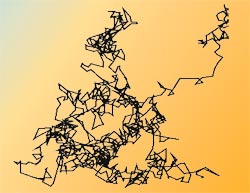
"Hudson, 2 dimensional Brownian motion is often compared to a drunken man wandering around the square. We don't see the logic, but it is there. The drunken man himself is most probably not aware of it. Just as we do not understand very well the processes of our creativity, we do not understand very well the processes of our lives and yet... and yet...as writers we attempt to describe our lives .... Hudson, Einstein used Brownian Motion to prove the existence of atoms, the make up of our lives. Trust me, writers need to understand the theory of Brownian Motion. Great writers already do."

"I smoked opium with Einstein once, Dead Beat."

"HUDSON!!"

Wednesday, December 13, 2006

How To Write A Great Short Story


Okay Dead Beat is about to give away the secret recipe. His Great Grandmother's actually - Mary Borden's Hearthy Pie.

1. Begin with nothing.
2. Search around in the dust particles visible through the light of your kitchen window engaging in Random Brownian Motion.
3. Notice an effect - call it Random Brownian Motion.
4. Learn the science of Randomness.
5. Limit your use of Space and Time.
6. Purchase character birth control.
7. Study the difference between sequence and series.
8. Introduce a sequence of events.
9. Recall the sequential events of Random Brownian Motion.
10. Introduce reflection.
11. Recall the Law of Reflection*
12. Combine sequential events and reflection in a manner which allows for depth and density**.
13. Appreciate that you do not understand the science of Step 12 and enrol in a lifelong research program.
14. Examine what you have discovered.
15. Remember you are first and foremost an entertainer.
16. Return to Step 2.

*The law of reflection states that when a ray of light reflects off a surface, the angle of incidence (the ray of light approaching the reflective surface) is equal to the angle of reflection (the ray of light which leaves the reflective surface).

**Density (symbol: ρ) is a measure of mass per volume. The average density of an object equals its total mass divided by its total volume. An object made from a comparatively dense material (such as iron) will have less volume than an object of equal mass made from some less dense substance (such as water).

Tuesday, December 12, 2006

Dead Beat Gives Yeats A Piece of His MInd

Dead Beat has a great interest in the mind - he has studied Hypnotherapy and NLP (Neuro Linguistic Programming) for many years and is qualified in both. So it should come as no great surprise that Old W.B. (see previous posts) would wish to communicate with him over this. W.B. himself being a great man for the 'mystical' things.

"Is that you Dead Beat? Is that you?" (Deep echoing voice resounding in my library)

"Is that you W.B.?"

"It is D.B. (Echo) It is."

"I thought you were fed up with me."

"I was, but you appeared nevertheless. Dead Beat I am here to tell you about 'automatic writing'."

"I know, I know. You and your wife, Georgie Hyde Lees. Dropped the 'i' to become George (something to do with numerology). You were the questioner and she the medium. Her hand was 'seized by a superiour power' and automatic writing the result."

"Yes, yes, D.B."

"Geez W.B. give me a break."

"D.B. It is the truth...(echo) truth...truth...On the afternoon of October 24th 1917, four days after my marriage, my wife surprised me by attempting automatic writing. What came in disjointed sentences, in almost illegible writing, was so exciting, sometimes so profound, that I persuaded her to give an hour or two day after day to the unknown writer, and after some half-dozen such hours offered to spend what remained of life explaining and piecing together those scattered sentences. ‘No,’ was the answer, ‘we have come to give you metaphors for poetry.’"

"Now remind me Willie Boy, you bought this?"

"I wrote about it all in A Vision."

"Strange book, W.B."

"My best, D.B."

"Give me The Tower, The Winding Stair."

"They could not have happened without automatic writing."

"Metaphors for your poetry...(bass echo) metaphors for your poetry..."

"A superior power, Dead Beat."

"Georgie and wishful thinking. Willie, I love you, you would have made a great student of NLP. Hate to break it to you though. There is no 'superior power', no 'muse' just logical processes within the mind we do not understand so well, but D.B. is doing his best to learn. You'd have liked me Willie. You really would."

Wednesday, December 06, 2006

Comedy and the Absurd - The Vaudeville of Writing


People sometimes bemoan the hapless form of the Marx Brothers in film - essentially they were bring a stage/vaudeville form to cinema. Clearly adaptations need to occur. The Brothers were hugely sucessful on stage. The attempt was to replicate this as much as possible for film. This was in the 'early' days of film remember.

Dead Beat is completely forgiving. Like Groucho he couldn't really stand the harp either. But like Groucho he understands that you need to give the audience time to allow their laughter to subside before the next onslaught. Highs and Lows - does this not sound like form to you?

Anyway Dead Beat is much more interested in the form of their comedy. This is where the goodies for us writers are kept.

This is the thing to remember: Comedy has form and structure.

Comedies have type characters. They begin in comic situations that develop in unconventional ways. In the case of the Marx Brothers the unconventional becomes 'wild', 'chaotic'. And we laugh.

Why?

Well there are three types of comedy: Farce, Romantic, and Satire.

The Marx Brothers are clearly in the former cagagory. Here we encounter zaniness, slapstick humour, hilarious improbability. The fantastic, the absurd, the ridiculous. Wild coincidences, twists and complications. Confusion abounds. Deception, mimicry, disguise and mistaken identity.

This latter point is of great interest to Dead Beat: Mistaken identity. Comedy questions identity, our identity just as great writers do in their works. Although it deals in stereotypes it uses these types to force us to recognise the absurd within us - the absurdity of life. Comedy is subversive and to be feared by the powerful.

Ignore its possibilities in your writing at your peril.