Add to Technorati Favorites

Alter Egos - I Am Done Watching This

When clicking on an Alter Egos in the sidebar, please look above this title for video content.
Showing posts with label Science of Writing. Show all posts

Thursday, December 04, 2008

That's Me! That's Me! - A Writing Guide

In 1958 you wrote "Pandemonium". What does pandemonium mean? What was the concept of this?

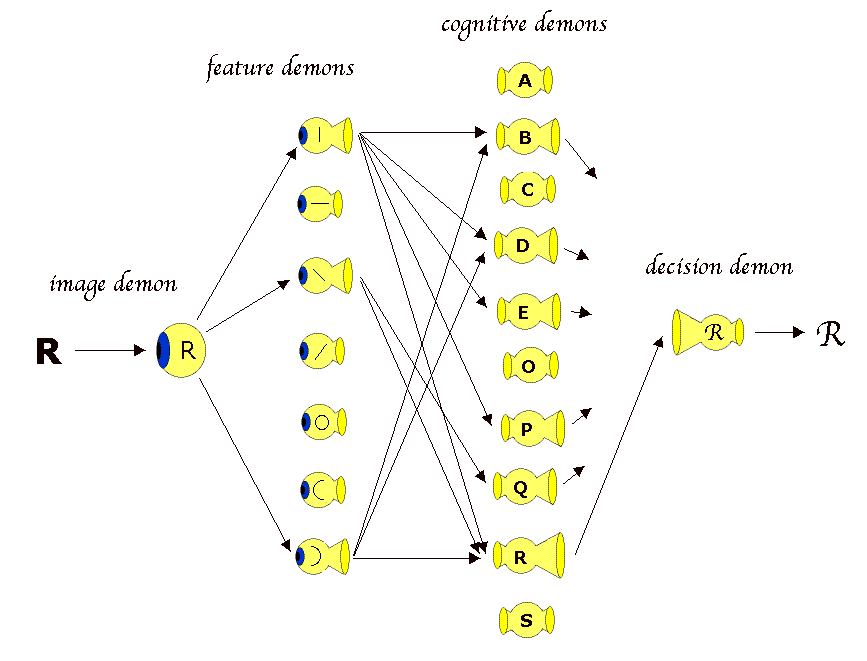
The concept, "pandemonium" was a word first used by John Milton in a very long English poem called "Paradise Lost". Pandemonium comes from the Greek "pan", meaning all and "demonium", meaning the demons. The idea of pandemonium is that in recognizing something - for example, recognizing a face or a character on a page - we have a little demon for each feature, for each part of the picture. And when the demons see themselves in the picture they shout, That's me! That's me! and then a higher level demon listens to these other demons and decides who shouts the loudest. If you are reading a character, a letter in a word, if the higher level demon hears the "A" demon shout the loudest, then he knows it is an "A". The idea is that we have separate neural nets, say, representing the demons, and what they shout, their output, is the amount of themselves that they see, that they perceive in what they are looking at.

So it's a network of neural networks at the end.

Yes, in the long run neural networks will have to be built up of pieces that are neural networks. But they still have to work together. Then the whole system does not have simple purposes or goals but very complex ones, just like people. In that sense the neural network is very different from the network of computers which we are talking about now because here it is a social thing. In our society not every piece, not every computer wants the same thing. They want to communicate but not because there is a single purpose; they want to communicate because everybody wants to do something different. In the neural network, in the good neural networks, they are all contributing to the same end.

Oliver Selridge: From Cybernetics to Neural Networks

Question 1: What are neural networks?

Answer: A neural network is a model of the way real nerves, real sensors like eyes and ears and brains, work. It tries to imitate so that it will work in the same way and do the same things.


Question 2: E' possibile costruire macchine, computer e altre apparecchiature con le reti neurali?

Answer: It is possible. We believe that our thinking works in a way like that and we want to find out how real brains work, and also to build machines to do some of the same things that our brains, our minds do.

Question 3: But these machines are not programmable. Will they learn by themselves?

Answer: One hopes so. They do learn by themselves, by their own experiences but not as much as people do. They are still very simple. The kinds of tasks that these machines can now do are low-level tasks. As science improves, as the engineers and scientists, the people at SMAU, work them and practice with them they get better, but they are still very far from real people.

Question 4: Can you compare the ability of neural networks with the ability of animals or children?

Answer: It is not an age so much. The neural network in the machine keeps trying, but an intelligent child stops trying after a while and gets bored. Our machines do not get bored yet, which is a sign that they are very elementary indeed. There are tasks which they can do for us. They will keep track of the right way to do a very easy task. But as yet they do not have much sense of purpose of their own beyond what they are given by the people who build them.

Question 5: That is interesting because they have to understand from the environment. How can they understand from the environment?

Answer: That is a very interesting point. It is not that they understand so much, it is that they work with the environment to get something done, to perceive something, to have the right effect. But they do not really understand what the environment is or how it works. So neural networks today do not make a model of the environment in the way that you and I make a model of the environment, instead they merely play with what they can do until it works.

Question 6: And can you compare the goals of cybernetics and the goals of neural networks?

Answer: The goals of neural networks are much more cybernetic than present day computers. Our computers are nearly all programmed, that is, they are told exactly what to do. Neural networks are not told exactly what to do. The study of cybernetics started out with Professor Norbert Wiener at MIT, who was my adviser, studying how gets to a particular place. The word cybernetics comes from the Greek word for the steersman on a boat, who moved the tiller or the rudder to get the boat where he wanted to go. The steersman is performing the goal, the seeking of the goal, the going where he wants to. At a very low level neural networks move their connections and rewire themselves so that the machine will do what it is programmed to want to do. In computers the programs are written so the machine will do what the designer wants them to do. So the machines in computers do not want. Neural networks are beginning to want, to care, to have purpose.

Demons and Pandemonium - The Stuff of Writing


D.B. notes that Oliver Selfridge sadly died in a fall at age 82. Selfridge was a pioneer in early computer science and artificial intelligence. And as D.B. fans know, every writer worth his or her salt needs to understand the complex processes of intelligence. How else to improve the creative processes.


Selfridge himself understood the connection between literature and intelligent processes. Selfridge envisioned the mind as a collection of tiny demons (this idea of the demon came to him after reading Paradise Lost!), each of whom responds to a name -- or something close to it -- being called out by other demons. When one thinks it is being called, it begins to yell out to other demons. The more certain it is that it is being called, the louder it yells, until some other demon thinks it is being called in turn. And so on. Selfridge called this pandemonium.


He used this idea to explain and model the way perceptual systems recognize stuff. For example, the letter R has one vertical line, a "belly" on the upper right, and a "leg" on the lower right. When "feature demons" whose names are "vertical," "belly," and "leg" (and others with names like "one," "upper right," and "lower right") hear their names being called, they begin to to call to the "cognitive demons." The cognitive demons named B and D, for example, may each prick up their ears, since they are "sensitized" to such calls as are given out by the vertical and belly demons. K may be listening, because it is listening for the calls of the vertical and leg demons. But only the R demon recognizes the calls of all three. So while B, D, and K may be calling out to the "decision demon," it will be R who calls the loudest.


As Doctor C. George Boeree says, "This may seem rather silly, but pandemonium provides a very good model for much of what goes on in the mind. The tip-of-the-tongue phenomenon, for example: You are trying to think of the name of that actress in Moulin Rouge. Her name starts with an N, you are certain. Nancy, Nadene, Norah, Natalie... damn. You could say the N demon is yelling, and several names are responding. Nicole! That's it: Nicole Kidman. "


How about the poets amongst us seeking out a rhyme or a particular work, metaphor even - think of the connections.

Monday, November 24, 2008

Explaining the Unexplainable - Kiyoshi Ito

Dead Beat notes that Kiyoshi Ito, a mathematician whose innovative models of random motion are used today in fields as diverse as finance and biology, died Nov. 17 at a hospital in Kyoto, Japan. He was 93.

Ito is known for his contributions to probability theory, the study of randomness. His work, starting in the 1940s, built on the earlier breakthroughs of Albert Einstein and Norbert Wiener. Mr. His mathematical framework for describing the evolution of random phenomena came to be known as the Ito Calculus.

“People all over realized that what Ito had done explained things that were unexplainable before.”

Monday, November 19, 2007

The Well-Suitedness of the Book

Dead Beat, as you know, has that old streak of engineering in him, and so has for years wondered how e-books or e-magazines or e-papers should work. About eight years ago he decided that it would require a flexible screen. Imagine the cover of a magazine - two sheets/four pages. Each page would be an individual screen which could download a single page of the book/mag/paper. In this way the reader could still turn pages, have the flexibility of paper, in other words the emotional expreience. Then he wondered would a single flexible sheet do: one leaf/two pages. Then he wondered would one page do AS LONG AS IT WAS FLEXIBLE.

So what's with the flexible?

Well, he knows reading a newspaer off a screen while you are sitting at a desk is not a relaxing experience always. Nor is it necessary relaxing to read it from a laptop. Hence the flexibility. Well, like all Dead Beat's great inventions (e.g. French Fry vending machine) someone else got up off their ar#e and created it.

But now let us add this into the frey:

Amazon.com , the world's largest Web retailer, said Monday it will begin selling an electronic book reader with wireless access, the latest attempt to build consumer interest in portable reading devices.

Wireless access, based on the cellphone broadband technology EVDO, is built into the 10-ounce, thin white device. Downloading content does not require a computer and takes less than a minute for a full-length book. The $399 electronic book device will allow downloads of more than 90,000 book titles, blogs, magazines and newspapers.

"The question is, can you improve upon something as highly evolved and well-suited to its task as the book? And if so, how?," Amazon.com Chief Executive Jeff Bezos said at a press conference in New York.

There it is. That's Dead Beat's point, thank you J.B.

The question is, can you improve upon something as highly evolved and well-suited to its task as the book?

Tuesday, November 13, 2007

The Arrogance of Writing


Dead Beat mourns the passing of Norman Mailer.


Nevertheless he is reminded how much they have in common.


For a start, Mailer like Dead Beat completed his degree in Engineering. "I studied it for the first couple of years and realized I didn't want to be an engineer and I wasn't going to be a good one. But I stayed on and got my degree in engineering."


See, you could never tell if it was Dead Beat or Mailer speaking here. And what about here:


"You almost can't become a serious professional writer unless there is a built-in arrogance in yourself that you have something special about yourself. It's a vanity, and when the vanity is misplaced, as it usually is, it's sad, if not tragic. But once in a while you're up to your own idea of yourself. "

Friday, October 19, 2007


Dead Beat is fuming at the mouth. So Dr Watson has upset many people with his "racist" views. I am sorry. I am sorry. Let me bring my old pal Dickie into the arguement:


"If Dr Watson is wrong he will be wrong scientifically, not ethically, and it is a scientific argument, not an ethical one, that will demonstrate his error. What is ethically wrong is the hounding, by what can only be described as an illiberal and intolerant 'thought police', of one of the most distinguished scientists of our time, out of the Science Museum, and maybe even out of the laboratory that [he] has devoted much of his life to building up a world-class reputation."


Yes Prof. Old Dr W. has been known for the odd gaffe, the unwelcomed comment, but let us look at this in a scientific way. Let the head rule the heart for once.


"The overwhelming desire of society today is to assume that equal powers of reason are a universal heritage of humanity," Watson tells us. "It may well be. But simply wanting this to be the case is not enough. This is not science. To question this," he added, "is not to give in to racism."


"Science is not here to make us feel good. It is to answer questions in the service of knowledge and greater understanding."


I know, I know, Dead Beat you're missing the point. Watson is a loose cannon, he is not scientifically supported...


The earth is round, the earth is flat.


Maybe he is off the wall, but let us leave the vitriol behind, let us return to the realm of science. Let Dr. Watson offer his evidence, let the rest of us offer ours.

Friday, October 05, 2007

The Domesticated Human


Ed Russell's back. I have the kettle boiling.


"Pull up a chair, Ed, green tea brewskies on the way."


"Something I forgot to say: Most of the literature on domestication implies that humans have sat in the driver's seat while other species rode in the back of the truck. The first word in the title of anthropologist Yi Fu-Tuan's analysis of pets, Dominance and Affection, reflects this view. For Perkins, who described the Green Revolution as one stage in a long evolutionary process, this unidirectional view is inadequate. "Wheat and people coevolved in ways that left neither much ability to prosper without the other," he argues. This bi-directional view opens the possibility that organisms domesticated humans as well as vice versa. Biologist Raymond P. Coppinger and English professor Charles Kay Smith have argued that since the last ice age, some 10,000 years ago, much of the most important evolution has taken place within the arena of human activity. Teaming up with humans was a good strategy for organisms faced with a rapidly changing environment."


"Domesticated humans. I like this alot Ed."


"Dead Beat, don't you think the time has come for us to understand such histories in a coherent way. Scholars in a variety of disciplines and fields have built the foundation for such an inquiry, with biology and history leading the way along parallel, but too rarely intersecting, paths. Evolutionary history offers a way to link these endeavors. To biology, history offers understanding of the social forces that create selective pressures. To history, biology offers understanding of the ways organisms respond to such pressures. Together, as evolutionary history, they offer understanding of the ever-changing dance between humans and nature. The resulting synthesis just might lead us to new understanding of historical episodes as disparate as state building, capital accumulation, geopolitics, industrialization, and domestication. If we are to understand how genetic engineering shapes human experience today and in the future, it behooves us to examine ways in which anthropogenic evolution has shaped us in the past."


To put it another way, dear readers, if we are to write about the human experience as we all claim to do, it behooves us to examine ways in which anthropogenic evolution has shaped us in the past.

Bearing the Mark of Anthropogenic Selection


Edmund Russell, associate professor of technology, culture, and communication and history at the University of Virginia, drops in for tea.


"It's got to be green," he tells me.

"None greener."

"Anyway," he goes on in between sips, "I like what you have been saying about evolutionary historians. You see Dead Beat humans have been shaping the evolution of so many other species, for so long, in so many ways, and for so many reasons that this process often has hidden in plain sight. In one morning, even before making it out the door, we might wake in bed sheets made of cotton, dress in clothes made of wool, put on shoes made of leather, eat a breakfast made of wheat, butter, oranges, and eggs, read a newspaper made of wood pulp and soy ink, pat a dog, and admire flowers on the table. Every one of these materials and creatures bears the mark of anthropogenic selection, from cotton bred for large bolls to flowers selected for their showy display. Every one of them has a history. Every one of these histories has resulted from social and biological forces. And every one of these histories tells us about ourselves as well as other species."

"Thanks for that, Ed. Insightful. The stuff my readers need to know."

"Glad to be of help. By the way, nice tea."

Wednesday, October 03, 2007

The Writer As Paleoanthropologist


It comes as no surprise to Dead Beat, amateur paleoanthropologist that he is, that Neanderthal skeletal remains have been found further east than previously known - in Southern Siberia and Uzbekistan.


Neanderthals as you know are our closest relatives - remains date back 400,000 years and they are believed to have died out about 30,000 years ago as modern humans spread around the world - yes, it's an old story.


Still and all, these nomadic traits are ever increasingly more important to the writer wishing to understand the human condition. Russell Banks got it right in Continental Drift and that was back in the mid-Eighties. Who can ever forget Bob Dubois?


Anyway, the thing that Dead Beat is urging here is that all of us who would lean towards the writing line of business should understand that we are evolutionary historians. There are no two ways about this, and no way around it.


Paleonthology. Physical Anthropology. That's the real business we are in.

Thursday, September 13, 2007

Constants, Units and Uncertainties


Dead Beat, as you know, considers an appreciation of science a necessary prerequisite for any writer worth their NaCl. He has a particular interest in constants.


Indeed he will never forget his Grade 8 science teacher trying to catch a gormless student unawares by asking if the constant k ever changed. The boy nodded silently that it did amid the guffaws of all. Even then Dead Beat felt angered, not so much by the unnecessary teasing but by the notion of a fixed unspecified value. The teacher being a priest, Dead Beat thought, should have known better in every regard.


But now it seems that the nodding boy may have the last laugh.


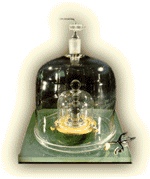
Dead Beat reads that the international prototype for the kilogram, kept tightly under lock and key in Sevres, outside Paris is losing weight. While the rest of the world is gaining weight and turning obese, the little kilogram does it's best to lose weight as some sort of counterbalance.


A little bit of history: At the end of the 18th century, a kilogram was the mass of a cubic decimeter of water. In 1889, the 1st CGPM sanctioned the international prototype of the kilogram, made of platinum-iridium, and declared: This prototype shall henceforth be considered to be the unit of mass.


The 3d CGPM (1901), in a declaration intended to end the ambiguity in popular usage concerning the word "weight," confirmed that: The kilogram is the unit of mass; it is equal to the mass of the international prototype of the kilogram.


Along with the prototype were dozens of copies - the reference kilogram has lost 50 micrograms
compared with the average of the copies.


Has the prototype got lighter or have the copies got heavier?


And so a better difinition if needed. Something more precise than the platinum-iridium cylinder. - just as the meter which was once defined as the distance between scratches on a bar, now involves the distance that light travels in a vacuum.


The ever varying constant. The writer and his search for a measure.

Tuesday, May 22, 2007

Pierre-Gilles de Gennes


Dead Beat learns that Pierre-Gilles de Gennes died on Friday in Orsay, Paris. De Gennes was awarded the 1991 Nobel Prize in physics for his work on liquid crystals, the form of matter that possess the fluidity of liquids but which can line up in an ordered state like solids.


Liquid crystals were known since the 1920s, but it was de Gennes who helped explain the mathematical and physical rules behind them, paving the way for further study and practical applications. Liquid crystals are now used in everything from pocket calculators to laptop computer screens.


He also established connections between the behaviour of liquid crystals and the behaviour of superconductors, two areas of study previously unconnected.


Perhaps Dead Beat himself will be awarded a Nobel proze for establishing connections between the behaviour of liquid crystals and the behaviour of written words, two areas of study previoucly unconnected.

Thursday, March 22, 2007

A Pretentiousness in Nature

Okay, I should be asleep by now - big trip tomorrow - but no, Dead Beat is still awake and worried about your writing.

Thing is, he still thinks that you most probably think he is distracted by science. Truth is he is distracted by nature.

Listen up to my pal David Quammen: "Let's broaden our thoughts by construing "nature" more carefully and inclusively. A volcanic eruption on Mars is nature. A black hole is nature. The atomic reactions occurring within the stars Mizar and Alkaid are nature. Dark matter is nature...By seeing nature big, seeing it as the realm within in which human enterprises such as science,m religion, and historiography occur, we may free ourselves from most of the old expectations and biases, positive and negative associated with what has commonly been understood by the term "nature writing."...Although nature writing in the traditional sense does include some clarion acts of literature (by Thoreau, Muir, and Leopold, for instance) and many other fine, steady, attentive works of observation and reflection, there has also been quite a lot of ethereal tripe. There have been too many purple effusions by one writer or another standing out in a forest or a meadow, misted by rain or spring pollen or pheromones and transfixed by the spectacle of his or her own sensitivity..."

SHARON BUTULA ARE YOU LISTENING?

Sorry folks but this is where this blog site came in, is it not?

She claims to dislike psychobabble and then engages in it ... much of her 'spiritual' intuition is a well understood cognitive process which she clearly does not understand. Don't get me wrong, she can write well, but there is no room for 'ethereal tripe'. As Quammen warns us "For the good of all concerned, we need the urban and trenchantly disposed to remain receptive to the subject of nature, in both its broad physical sense and its narrow biological senses, and we need the self-identified lovers of nature to maintain an edge of critical intelligence."

Otherwise the subtitle "An Apprenticeship in Nature" translates directly into "A Pretentiousness in Nature."

Quammen has his finger on the pulse. Too much tripe out there. Our job is to go deeper than that. I use Sharon Butula as a metaphor, but if even she cannot hack it (and she can't - she brings hysteria instead and contributes to our misunderstanding of 'nature'), then we have all a long way to go.

Monday, March 19, 2007

Tolstoy and Other Infections


So we were talking about Tolstoy. In his What is Art? he theorises that art is the contagion of feeling. Are we talking viruses by any chance? He infects the audience with the feelings he himself experiences. Indeed he wants to use this theory as a criterion for the evaluation of art. Well my old friend Anne Sheppard would tell us that, “much of Tolstoy’s condemnation of art derives from his moral outlook and he fails, or refuses, to make any distinction between the moral and the aesthetic.”

So up yours, Leo!

“She goes on to say, “It is often claimed that a characteristic feature of aesthetic experience is a certain emotional detachment, that in true art emotions are not directly aroused, we are not moved to immediate action but remain in a state of contemplative appreciation.”

Douglas Adams, Tolstoy, viruses, Art. Old Hof would be proud of.
Anyway think about it. Your words depend on this.

Sunday, March 18, 2007

The Real Solid Red Meat of Science - or - The Novel as Light Relief


Richard Dawkins and Dead Beat are old pals. So it should come as no surprise that he has been keeping tabs on D.B.' posts.


"Like what you are about D.B. Tell it as it is."


"Science really."


"I was talking to Douglas Adams some years back. He studied English literature at Cambridge, but he was telling me how his reading habits have changed: "I think I read much more science than novels. I think the role of the novel has changed a little bit. In the nineteenth century the novel was where you went to get your serious reflections and questionings about life. You'd go to Tolstoy and Dostoevsky. Nowadays, of course, you know the scientists actually tell us much much more about such issues than you would ever get from novelists. So I think for the real solid red meat of what I read I go to science books, and read some novels as light relief.""


"We're becoming vegetarians, Rich. That's the problem with us novelists. We need to kill more animals."

Friday, March 16, 2007

The Spirit of Kepler and other Celestial Matters


So Dead Beat isn't letting you away too easily. I know you wish he'd shut up about analogy and the creative process and just allow you all to get on with your writing, and for a while I thought I would, but just then who should materialise in the middle of a particularly cold and wintry night but Kepler himself. Yes that Kepler, Johannes.


Dead Beat props himself up on his down filled pillow. "Shut the screen door, Johannes."


"No time, no time."


"Speaking of time, what the hell time is it." Dead Beat notices that his clock has stopped upon his wall. The pendulum has ceased its motion.


"I know not the hour nor the year nor the century, Dead Beat."


"I know the feeling," D.B. groans wondering how many Guinness he had the night before.


"You speak of creativity and analogy."


"In a manner. Hof really."


"The roads by which men arrive at their insights into celestial matters seem to
me almost as worthy of wonder as those matters in themselves ."


Dead Beat rises to the bait.


"My thoughts exactly Johannes."


"In Astronomia Nova I say:
Here it is a question not only of leading the reader to an understanding of the subject matter in the easiest way, but also, chiefly, of the arguments, meanderings, or even chance occurrences by which I the author first came upon that understanding . Thus, in telling of Christopher Columbus, Magellan, and of the Portuguese, we do not simply ignore the errors by which the first opened up America, the second, the China Sea, and the last, the coast of Africa ; rather, we would not wish them omitted, which would indeed be to deprive ourselves of an enormous pleasure in reading ."


"Yes, you did, didn't you. The process of understanding being as important as the understanding itself."


"Dead Beat, we are kindred spirit."


"Did you mention spirits, Johannes? A wee tipple perhaps?"


"Just a small one," handing across his tumbler.


"Go on..."


"I therefore display these occasions [errors and meanderings] scrupulously, with, no doubt, some attendant difficulty for the reader. Nevertheless, that victory is sweeter that was born in danger, and the sun emerges from the clouds with redoubled splendour."


He sips from his glass. I sip from the bottle.


"I enjoy recognizing my errors, Dead Beat, because they tell me by what meanders, and by feeling along what walls through the darkness of ignorance,
I have reached the shining gateway of truth."


"We could all learn from this. Us scribes. Kep, you were a prolific analogizer, were you not? Not only in your books but also in your journals and letters, you used analogies constantly . In some cases the analogies seem simply playful . In other cases, analogizing is integral to your theorizing."


"Ah, yes D.B."


"We could, could we not trace your analogical processes, using structure-mapping theory to trace your inferences and analogical extensions. We could show that with reasonable representational assumptions we could simulate some, though not all, of your mapping processes."


"T'was my intention."


"T'was my intention to get a good night's sleep and to do the same thing for creativity in writing."


"Science, writing, D.B. What is the difference?"


And with that the clouds slid across the moon, the room went dark and the shutters banged emptily.


Slowing Down the Years - Dead Beat Discovers the Secret of Eternal Youth


So Hofstadter's second riddle:


“Why does each new year seem to pass faster than the one before?”


Hofstadter explains: The more we live, the larger our repertoire of concepts becomes, which allows us to gobble up ever larger coherent stretches of life in single mental chunks. As we start seeing life’s patterns on higher and higher levels, the lower levels nearly vanish from our perception. This effectively means that seconds, once so salient to our baby selves, nearly vanish from sight, and then minutes go the way of seconds, and soon so do hours, and then days, and then weeks...


“Boy, this year sure went by fast!” is so tempting to say because each year is perceived in terms of chunks at a higher, grander, larger level than any year preceding it, and therefore each passing year contains fewer top-level chunks than any year preceding it, and so, psychologically, each year seems sparser than any of its predecessors. One might, somewhat facetiously, symbolize the ever-rapider passage of time by citing the famous harmonic series:
1 + 1/2 + 1/3 + 1/4 + 1/5 + 1/6 + 1/7 + 1/8 +...


by which I mean to suggest that one’s nth year feels subjectively n times as short as one’s first year, or n/5 times as short as one’s fifth year, and so on. Thus when one is an adult, the years seem to go by about at roughly a constant rate, because — for instance — (1/35)/(1/36) is very nearly 1. Nonetheless, according to this theory, year 70 would still shoot by twice as fast as year 35 did, and seven times as fast as year 10 did.


But the exact numerical values shown above are not what matter; I just put them in for entertainment value (who else but Hof and D.B. would throw in harmonic series for light relief?). The more central and more serious idea is simply that relentless mental chunking makes life seem to pass ever faster as one ages, and there is nothing one can do about it."


So what gives?


Chunking and analogy gives.


Your poem is built in chunks and so too are your stories and your novels, your memoirs and anything else you care to writer.


Your mind produces the words and the sequences of words, images etc through analogy.


Some sensory or abstract input triggers "prior mental categories". These categories "are quintessentially fluid entities; they adapt to a set of incoming stimuli and try to align themselves with it. The process of inexact matching between prior categories and new things being perceived (whether those “things” are physical objects or bite-size events or grand sagas) is analogy-making par excellence."


Creativity is not bestowed upon us by some airy fairy muse but by mental processes we re only now beginning to understand.


Spend some time exploring your own mapping systems. Who knows maybe you can slow down the years.

Tuesday, March 13, 2007

Jane Smiley and Dead Beat Spreading Viruses


So Jane Smiley has been reading Dead Beat (see I Bet You Can’t Repeat The Title Of This Blog) and pilfering his ideas. "The novel is like a virus," she said, "it moves silently around a culture; it either takes hold, or it doesn't."


Well never mind. Dead Beat reads Jane Smiley and has no problem pilfering her ideas about form.


Go ahead, read her. Learn a thing or two.


Oops, did I just spread a virus?

Sunday, March 11, 2007

Dead Beat Poses Some Riddles

Hof has two riddles for us. Well you know Dead Beat, he has a sense of humour. He likes riddles. So Hofs, sock it to us.

"Two Riddles

We begin with a couple of simple queries about familiar phenomena: “Why do babies not remember events that happen to them?” and “Why does each new year seem to pass faster than the one before?”

I wouldn’t swear that I have the final answer to either one of these queries, but I do have a hunch, and I will here speculate on the basis of that hunch. And thus: the answer to both is basically the same, I would argue, and it has to do with the relentless, lifelong process of chunking — taking “small” concepts and putting them together into bigger and bigger ones, thus recursively building up a giant repertoire of concepts in the mind.

How, then, might chunking provide the clue to these riddles? Well, babies’ concepts are simply too small. They have no way of framing entire events whatsoever in terms of their novice concepts. It is as if babies were looking at life through a randomly drifting keyhole, and at each moment could make out only the most local aspects of scenes before them. It would be hopeless to try to figure out how a whole room is organized, for instance, given just a keyhole view, even a randomly drifting keyhole view.

Or, to trot out another analogy, life is like a chess game, and babies are like beginners looking at a complex scene on a board, not having the faintest idea how to organize it into higher-level structures. As has been well known for decades, experienced chess players chunk the setup of pieces on the board nearly instantaneously into small dynamic groupings defined by their strategic meanings, and thanks to this automatic, intuitive chunking, they can make good moves nearly instantaneously and also can remember complex chess situations for very long times. Much the same holds for bridge players, who effortlessly remember every bid and every play in a game, and months later can still recite entire games at the drop of a hat.

All of this is due to chunking, and I speculate that babies are to life as novice players are to the games they are learning."

Now folks, I think we will leave the next riddle until another time since that has you rolling in the aisles. Seriously, stay with Dead Beat. Think about what Hof is revealing to us.

Complex chess moves, complex writing techniques. Chess masters, word masters. We have a 'giant repertoire of concepts in our minds' which we can utilize in the pulling together of the vast array of formal techniques available to us. Automatic intuitive chunking. We do it all the time. Let us learn to do it even better.

Great Writing and the Appreciation of Analogy

q

Mapping and analogy. Go back and re-read if you have forgotten. This is important stuff, Dead Beat does not lie.


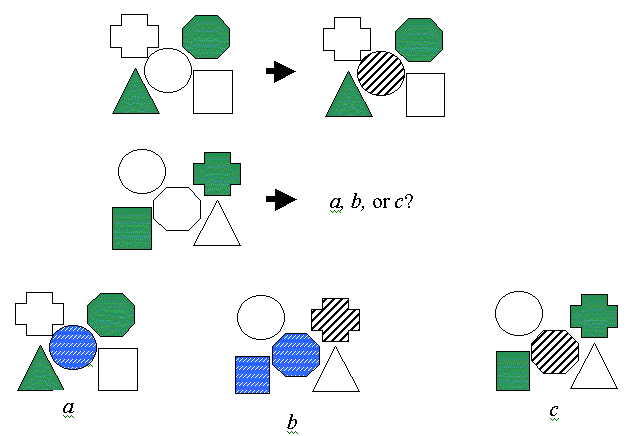
Remember Hofstadter is concerned with developing computer models of how human thinking works. You see this is the core of it. We can talk about form in writing. We can 'instruct' in the craft - characters, setting, line, imagery, rhythm and so on, but how do we utilize it? What is happening in the minds of writers?


Why do two people with the same understanding of form produce different 'qualities' of work?


What makes a great poet great? We know what is happening on the page - we can see formally what has occurred? But what happened in the mind to allow this to occur? What processes were at work? And if we could model them, could we then 'teach' them?


Could we become better writers?


Dead Beat says, you bet!


Keep in mind that 'the great poet' probably does not really know what is occurring in his or her mind.


So analogy. Here is what Hofstadter says: One should not think of analogy-making as a special variety of reasoning (as in the dull and uninspiring phrase “analogical reasoning and problem-solving,” a long-standing cliché in the cognitive-science world), for that is to do analogy a terrible disservice. After all, reasoning and problem-solving have (at least I dearly hope!) been at long last recognized as lying far indeed from the core of human thought. If analogy were merely a special variety of something that in itself lies way out on the peripheries, then it would be but an itty-bitty blip in the broad blue sky of cognition. To me, however, analogy is anything but a bitty blip — rather, it’s the very blue that fills the whole sky of cognition — analogy is everything, or very nearly so, in my view."


So what is analogy and how can we utilize it to improve our writing abilities:?


Stay with Dead Beat, he has Hof''s ear.