Add to Technorati Favorites

Alter Egos - I Am Done Watching This

When clicking on an Alter Egos in the sidebar, please look above this title for video content.
Showing posts with label Writing Process. Show all posts

Thursday, December 27, 2007

A Fully Developed Sense of Humor

End of the year - and everyone is counting up the best of the year. Best Book, Best Film, Best Concert, Best Album, Best Absentee Underwear... Best Who Cares?

Dead Beat is Stuck in Stuckism. Tracy Emin, Damien Hirst, Billy Childish - Ow, they all exclaim. I'm not a Medway Poet. I did not sleep in Tracy's tent (well what the heck, who did sleep - nudge nudge!) Fact is everyone slept. Hirst should be dropped in formaldehyde and exhibited. Emin should be poured over a Christmas Pudding and lit. And as for Billy Childish... let's just expel him from college and admit the Brit Pack is lack-ing. When Kylie Minogue name checks you in her ...album title...it's time to knit yourself out of a relationship...

One purl, one plain, one purl, one plain.

Wednesday, December 05, 2007

Dancing Dan's Christmas

Dead Beat learned just about everything he knows from Damon Runyon (and maybe even a little more...) So seeing as it is Christmas almost, how better to start the season than the opening to Dancing Dan's Christmas. Word to the wise. Get your hands on everything D.R. ever wrote, read and then re-read.

"NOW one time it comes on Christmas, and in fact it is the evening before Christmas, and I am in Good Time Charley Bernstein's little speakeasy in West Forty-seventh Street, wishing Charley a Merry Christmas and having a few hot Tom and Jerrys with him. This hot Tom and Jerry is an old time drink that is once used by one and all in this country to celebrate Christmas with, and in fact it is once so popular that many people think Christmas is invented only to furnish an excuse for hot Tom and Jerry, although of course this is by no means true. But anybody will tell you that there is nothing that brings out the true holiday spirit like hot Tom and Jerry, and I hear that since Tom and Jerry goes out of style in the United States, the holiday spirit is never quite the same. The reason hot Tom and Jerry goes out of style is because it is necessary to use rum and one thing and another in making Tom and Jerry, and naturally when rum becomes illegal in this country Tom and Jerry is also against the law, because rum is something that is very hard to get around town these days. For a while some people try making Tom and Jerry without putting rum in it, but somehow it never has the same old holiday spirit, so nearly everybody finally gives up in disgust, and this is not suprising, as making Tom and Jerry is by no means child's play. In fact, it takes quite an expert to make good Tom and Jerry, and in the days when it is not illegal a good hot Tom and Jerry maker commands good wages and many friends. Now of course Good Time Charley and I are not using rum in the Tom and Jerry we are making, as we do not wish to do anything illegal. What we are using is rye whisky that Good Time Charley gets on a doctor's prescription from a drug store, as we are personally drinking this hot Tom and Jerry and naturally we are not foolish enough to use any of Good Time Charley's own rye in it. The prescription for the rye whisky comes from old Doc Moggs, who prescribes it for Good Time Charley's rheumatism in case Charley happens to get rheumatism, as Doc Moggs says there is nothing better for rheumatism than rye whisky, especially if it is made up in a hot Tom and Jerry. In fact, old Doc Moggs comes around and has a few seidels of hot Tom and Jerry with us for his own rheumatism...

Tuesday, September 25, 2007

The Gestalt Approach Of A Real Writer


"Hey Daniel Berkeley."

"Dead Beat."

"So what's on your mind today. More deconstruction of the craft of narrative?"

"God forbid."

"What, don't you like teaching all those Dead Beaters out there a thing or two about the business?"

" This effort of approaching a piece of fiction as though there's something slightly wrong with it that can be fixed is maybe not the gestalt approach that a real writer ought to have. "

"Shoot, there goes my livelihood."

"Why don't you write for a livelihood?"

"Hah hah, very funny. We can't all be Updikes."

"Most of the writing world aspires to be. But really Dead Beat I did write a lot of light verse, and even some verse that wasn't too light. Even I knew there was no living in being a poet, so fiction was the game."

"Game, Daniel Berkeley?"

"Yes of course Dead Beat, what else could you call it? I found when I attempted fiction it's like sort of a horse you don't know is there, but if you jump on the back there is something under you that begins to move and gallop."

"A sort of horse game then?"

"The trick about fiction, Dead Beat, as I see it, is to make an unadventurous circumstance seem adventurous, to make it excite the reader, either with its truth or with the fact that there's always a little more that goes on, and there's multiple levels of reality."


So there you have it. Writing is but a game, and there is a trick to it which you all now know. So what are you waiting for, you aspiring Updikes, go to it!

Friday, September 21, 2007

New Room For Shapelessness


So Updike returns. "Hey Dead Beat."

"Hey Daniel Berkeley."

"What I was saying about Salinger."

"Weaving fiction from seemingly unconnected events."

"Yeah. Well I got to thinking. You see like most innovative writers he made new room for shapelessness, for life as it is lived. I'm thinking of a story like "Just Before The War With The Eskimos.""

"Don't you forget it. There's been times you haven't been so kind to Mr. Sal."

"Goddamn Glass family!"

'Life as it is lived."


Monday, September 17, 2007

Updike Has His Eyes Opened


"Dead Beat?"

"Yeah."

"Updike here."

"Who?"

"Updike."

"Sorry, I think you got a wrong number."

"I need to tell you something."

"Daniel Berkeley Updike: American printer and scholar, founder in 1893 of the distinguished Merrymount Press?"

"John Updike."

"John....John... Name rings a bell. Merchant banker?"

"World famous prose writer."

"Why thank you, I am."

"Not you Dead Beat, me, John Updike. All those Rabbit books."

"Oh, now I got you. Wrote one on Golden Retrievers too. Hudson seemed to like that."

"Not those sort of rabbits, human ones."

"Oh like science fiction."

"Can it, Dead Beat. I got something to tell you. It's about Sal."

"Shoot."

"The short stories of J.D. Salinger really opened my eyes as to how you can weave fiction out of a set of events that seem almost unconnected, or very lightly connected."

"So what are you saying, that all writers of fiction would be well advised to read his stories?"

"I'm saying they really opened my eyes."

"So all writers of fiction should have their eyes opened?"

"I'm saying my eyes were opened."

"Got you, Daniel Berkeley. I'll pass that advice on."


So from one D.B. to another D.B. to all you writers out there. Read Salinger, have your eyes opened.


Thursday, September 13, 2007

Constants, Units and Uncertainties


Dead Beat, as you know, considers an appreciation of science a necessary prerequisite for any writer worth their NaCl. He has a particular interest in constants.


Indeed he will never forget his Grade 8 science teacher trying to catch a gormless student unawares by asking if the constant k ever changed. The boy nodded silently that it did amid the guffaws of all. Even then Dead Beat felt angered, not so much by the unnecessary teasing but by the notion of a fixed unspecified value. The teacher being a priest, Dead Beat thought, should have known better in every regard.


But now it seems that the nodding boy may have the last laugh.


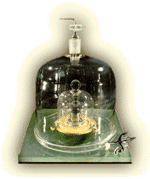
Dead Beat reads that the international prototype for the kilogram, kept tightly under lock and key in Sevres, outside Paris is losing weight. While the rest of the world is gaining weight and turning obese, the little kilogram does it's best to lose weight as some sort of counterbalance.


A little bit of history: At the end of the 18th century, a kilogram was the mass of a cubic decimeter of water. In 1889, the 1st CGPM sanctioned the international prototype of the kilogram, made of platinum-iridium, and declared: This prototype shall henceforth be considered to be the unit of mass.


The 3d CGPM (1901), in a declaration intended to end the ambiguity in popular usage concerning the word "weight," confirmed that: The kilogram is the unit of mass; it is equal to the mass of the international prototype of the kilogram.


Along with the prototype were dozens of copies - the reference kilogram has lost 50 micrograms
compared with the average of the copies.


Has the prototype got lighter or have the copies got heavier?


And so a better difinition if needed. Something more precise than the platinum-iridium cylinder. - just as the meter which was once defined as the distance between scratches on a bar, now involves the distance that light travels in a vacuum.


The ever varying constant. The writer and his search for a measure.

Tuesday, September 11, 2007

A Perfect Day For Bananafish


So Dead Beat's old croony J.D wants in on the discussion of legend and myth.


"What's up Sal?"

"It's this distinction you draw between legend and myth D.B."

"What are you saying?"

"I'm saying, it doesn't have to be an either or. Look at me for crying out loud, part legend, part myth."

"So a story could be both."

"Haven't you read A Perfect Day For Bananafish."

"Read it J.D.? I live it out each and every day."

"That's all I wanted to say."

"Much appreciated. Now tell me, what are you doing tonight? Want to paint the town red?"

Monday, September 10, 2007

Dead Beat - A Myth or a Legend?


So myth and legend.


The main thing to remember is that in myth the story is timeless and the events are symbolic.

In a legend the story is told as though it were a historical event and does not have a symbolic narrative.


Myths it has been said are stories shared by a group which are a part of their cultural identity.


And so as writers, creators of stories, we need to keep this in mind.

Tuesday, June 05, 2007

Good Poetry Is A Beer Shit


Bukowski Wants To Tell You This


But did you listen?


Dead Beat wants you to listen closely: "Reading the poets has been the dullest of things...many of the great poets of the past, I've read their stuff. I've read it. All I get is a goddamn headache, boredom. I really feel sickness in the pit of my stomach, I say, there's some trick going on here. This is not true, this is not real, it's not good. You see poetry itself contains as much energy as a Hollywood industry, as much energy as a stage play on Broadway. All it needs are practitioners who are alive to bring it alive. Poetry is always said to be a private hidden heart which is not appreciated. The reason it is not appreciated is because it hasn't shown any guts, hasn't shown any dance, hasn't shown any moxy... Those who say the poet is a private and precious person I don't agree with. Generally he is just a dumb feddling asshole writing insecure lines that don't come through, believing he's immortal, waiting for his immortality, which never arrives because the poor fucker just can't write...nothing should ever be done that should be done. It has to come out like a good hot beer shit. A good hot beer shit is glorious man , you get up, you turn around, you look at it, your proud, the fumes, the stink of the turds, you look at it, you say God I did it, I'm good. The you flush it away. Then there's that sense of sadness, and just the water is there. It's like writing a good poem. You just do it. It's a beer shit. It's nothing to analyse. There's nothing to say. It's just done. Got it..."


I got it Buk. I got it.

Tuesday, May 15, 2007

A Sort of Witness


Ray turned up in my dreams last night.


"Dead Beat, a few words to the wise: A writer ought to speak about things that are important to him. As you know, I've taught in universities, in fact for some fifteen years. I had time there for other work, and I never wrote a single story about university life because it's an experience that left no mark on my emotional life. I tend to go back to the time and the people I knew well when I was younger and who made a very strong impression on me . . . Some of my recent stories deal with executives. (For example, that one in The New Yorker, "Whoever Was Using This Bed," where the people discuss things the ¥charaters in my earlier stories would never discuss.) He's a businessman, and so on. But most of the people in my stories are poor and bewildered, that's true. The economy, that's important . . . I don't feel I'm a political writer and yet I've been attacked by right-wing critics in the U.S.A. who blame me for not painting a more smiling picture of America, for not being optimistic enough, for writing stories about the people who don't succeed. But these lives are as valid as those of the go-getters. Yes, I take unemployment, money problems, and marital problems as givens in life. People worry about their rent, their children, their home life. That's basic. That's how 80-90 percent, or God knows how many people live. I write stories about a submerged population, people who don't always have someone to speak for them. I'm sort of a witness, and, besides, that's the life I myself lived for a long time. I don't see myself as a spokesman but as a witness to these lives. I'm a writer. "

Monday, April 23, 2007

Dead Beat's Been Bending Spoons Again

Strange as it might sound, Dead Beat has been at a loss for words recently. Something about his trip home stalled him in his tracks. The fact the ice is gone and the geese are back might have something to do with it too.

In the meantime he whiles his time away reading magic books. What else are writers if not illusionists? How else can we expect to improve our craft?

Move over Uri Geller Dead Beat's hitting town.

Monday, March 19, 2007

What Is Art - Leo Tolstoy


So Leo old chum, what is art?


"Art is not, as the metaphysicians say, the manifestation of some mysterious idea of beauty or God; it is not, as the aesthetical physiologists say, a game in which man lets off his excess of stored-up energy; it is not the expression of man's emotions by external signs; it is not the production of pleasing objects; and, above all, it is not pleasure; but it is a means of union among men, joining them together in the same feelings, and indispensable for the life and progress toward well-being of individuals and of humanity."


Metaphysicians, aesthetical physiologists... more Leo... more...


"Art begins when one person, with the object of joining another or others to himself in one and the same feeling, expresses that feeling by certain external indications. To take the simplest example: a boy, having experienced, let us say, fear on encountering a wolf, relates that encounter; and, in order to evoke in others the feeling he has experienced, describes himself, his condition before the encounter, the surroundings, the woods, his own lightheartedness, and then the wolf's appearance, its movements, the distance between himself and the wolf, etc. All this, if only the boy, when telling the story, again experiences the feelings he had lived through and infects the hearers and compels them to feel what the narrator had experienced is art. If even the boy had not seen a wolf but had frequently been afraid of one, and if, wishing to evoke in others the fear he had felt, he invented an encounter with a wolf and recounted it so as to make his hearers share the feelings he experienced when he feared the world, that also would be art. And just in the same way it is art if a man, having experienced either the fear of suffering or the attraction of enjoyment (whether in reality or in imagination) expresses these feelings on canvas or in marble so that others are infected by them. And it is also art if a man feels or imagines to himself feelings of delight, gladness, sorrow, despair, courage, or despondency and the transition from one to another of these feelings, and expresses these feelings by sounds so that the hearers are infected by them and experience them as they were experienced by the composer."


So...? What is art?


"We are accustomed to understand art to be only what we hear and see in theaters, concerts, and exhibitions, together with buildings, statues, poems, novels. . . . But all this is but the smallest part of the art by which we communicate with each other in life. All human life is filled with works of art of every kind - from cradlesong, jest, mimicry, the ornamentation of houses, dress, and utensils, up to church services, buildings, monuments, and triumphal processions. It is all artistic activity. So that by art, in the limited sense of the word, we do not mean all human activity transmitting feelings, but only that part which we for some reason select from it and to which we attach special importance. "

Dead Beaters, if you are going to create art, the least you can do is figure out what it really is.

Sunday, March 18, 2007

The Real Solid Red Meat of Science - or - The Novel as Light Relief


Richard Dawkins and Dead Beat are old pals. So it should come as no surprise that he has been keeping tabs on D.B.' posts.


"Like what you are about D.B. Tell it as it is."


"Science really."


"I was talking to Douglas Adams some years back. He studied English literature at Cambridge, but he was telling me how his reading habits have changed: "I think I read much more science than novels. I think the role of the novel has changed a little bit. In the nineteenth century the novel was where you went to get your serious reflections and questionings about life. You'd go to Tolstoy and Dostoevsky. Nowadays, of course, you know the scientists actually tell us much much more about such issues than you would ever get from novelists. So I think for the real solid red meat of what I read I go to science books, and read some novels as light relief.""


"We're becoming vegetarians, Rich. That's the problem with us novelists. We need to kill more animals."

Friday, March 16, 2007

The Spirit of Kepler and other Celestial Matters


So Dead Beat isn't letting you away too easily. I know you wish he'd shut up about analogy and the creative process and just allow you all to get on with your writing, and for a while I thought I would, but just then who should materialise in the middle of a particularly cold and wintry night but Kepler himself. Yes that Kepler, Johannes.


Dead Beat props himself up on his down filled pillow. "Shut the screen door, Johannes."


"No time, no time."


"Speaking of time, what the hell time is it." Dead Beat notices that his clock has stopped upon his wall. The pendulum has ceased its motion.


"I know not the hour nor the year nor the century, Dead Beat."


"I know the feeling," D.B. groans wondering how many Guinness he had the night before.


"You speak of creativity and analogy."


"In a manner. Hof really."


"The roads by which men arrive at their insights into celestial matters seem to
me almost as worthy of wonder as those matters in themselves ."


Dead Beat rises to the bait.


"My thoughts exactly Johannes."


"In Astronomia Nova I say:
Here it is a question not only of leading the reader to an understanding of the subject matter in the easiest way, but also, chiefly, of the arguments, meanderings, or even chance occurrences by which I the author first came upon that understanding . Thus, in telling of Christopher Columbus, Magellan, and of the Portuguese, we do not simply ignore the errors by which the first opened up America, the second, the China Sea, and the last, the coast of Africa ; rather, we would not wish them omitted, which would indeed be to deprive ourselves of an enormous pleasure in reading ."


"Yes, you did, didn't you. The process of understanding being as important as the understanding itself."


"Dead Beat, we are kindred spirit."


"Did you mention spirits, Johannes? A wee tipple perhaps?"


"Just a small one," handing across his tumbler.


"Go on..."


"I therefore display these occasions [errors and meanderings] scrupulously, with, no doubt, some attendant difficulty for the reader. Nevertheless, that victory is sweeter that was born in danger, and the sun emerges from the clouds with redoubled splendour."


He sips from his glass. I sip from the bottle.


"I enjoy recognizing my errors, Dead Beat, because they tell me by what meanders, and by feeling along what walls through the darkness of ignorance,
I have reached the shining gateway of truth."


"We could all learn from this. Us scribes. Kep, you were a prolific analogizer, were you not? Not only in your books but also in your journals and letters, you used analogies constantly . In some cases the analogies seem simply playful . In other cases, analogizing is integral to your theorizing."


"Ah, yes D.B."


"We could, could we not trace your analogical processes, using structure-mapping theory to trace your inferences and analogical extensions. We could show that with reasonable representational assumptions we could simulate some, though not all, of your mapping processes."


"T'was my intention."


"T'was my intention to get a good night's sleep and to do the same thing for creativity in writing."


"Science, writing, D.B. What is the difference?"


And with that the clouds slid across the moon, the room went dark and the shutters banged emptily.


Slowing Down the Years - Dead Beat Discovers the Secret of Eternal Youth


So Hofstadter's second riddle:


“Why does each new year seem to pass faster than the one before?”


Hofstadter explains: The more we live, the larger our repertoire of concepts becomes, which allows us to gobble up ever larger coherent stretches of life in single mental chunks. As we start seeing life’s patterns on higher and higher levels, the lower levels nearly vanish from our perception. This effectively means that seconds, once so salient to our baby selves, nearly vanish from sight, and then minutes go the way of seconds, and soon so do hours, and then days, and then weeks...


“Boy, this year sure went by fast!” is so tempting to say because each year is perceived in terms of chunks at a higher, grander, larger level than any year preceding it, and therefore each passing year contains fewer top-level chunks than any year preceding it, and so, psychologically, each year seems sparser than any of its predecessors. One might, somewhat facetiously, symbolize the ever-rapider passage of time by citing the famous harmonic series:
1 + 1/2 + 1/3 + 1/4 + 1/5 + 1/6 + 1/7 + 1/8 +...


by which I mean to suggest that one’s nth year feels subjectively n times as short as one’s first year, or n/5 times as short as one’s fifth year, and so on. Thus when one is an adult, the years seem to go by about at roughly a constant rate, because — for instance — (1/35)/(1/36) is very nearly 1. Nonetheless, according to this theory, year 70 would still shoot by twice as fast as year 35 did, and seven times as fast as year 10 did.


But the exact numerical values shown above are not what matter; I just put them in for entertainment value (who else but Hof and D.B. would throw in harmonic series for light relief?). The more central and more serious idea is simply that relentless mental chunking makes life seem to pass ever faster as one ages, and there is nothing one can do about it."


So what gives?


Chunking and analogy gives.


Your poem is built in chunks and so too are your stories and your novels, your memoirs and anything else you care to writer.


Your mind produces the words and the sequences of words, images etc through analogy.


Some sensory or abstract input triggers "prior mental categories". These categories "are quintessentially fluid entities; they adapt to a set of incoming stimuli and try to align themselves with it. The process of inexact matching between prior categories and new things being perceived (whether those “things” are physical objects or bite-size events or grand sagas) is analogy-making par excellence."


Creativity is not bestowed upon us by some airy fairy muse but by mental processes we re only now beginning to understand.


Spend some time exploring your own mapping systems. Who knows maybe you can slow down the years.

Sunday, March 11, 2007

Dead Beat Poses Some Riddles

Hof has two riddles for us. Well you know Dead Beat, he has a sense of humour. He likes riddles. So Hofs, sock it to us.

"Two Riddles

We begin with a couple of simple queries about familiar phenomena: “Why do babies not remember events that happen to them?” and “Why does each new year seem to pass faster than the one before?”

I wouldn’t swear that I have the final answer to either one of these queries, but I do have a hunch, and I will here speculate on the basis of that hunch. And thus: the answer to both is basically the same, I would argue, and it has to do with the relentless, lifelong process of chunking — taking “small” concepts and putting them together into bigger and bigger ones, thus recursively building up a giant repertoire of concepts in the mind.

How, then, might chunking provide the clue to these riddles? Well, babies’ concepts are simply too small. They have no way of framing entire events whatsoever in terms of their novice concepts. It is as if babies were looking at life through a randomly drifting keyhole, and at each moment could make out only the most local aspects of scenes before them. It would be hopeless to try to figure out how a whole room is organized, for instance, given just a keyhole view, even a randomly drifting keyhole view.

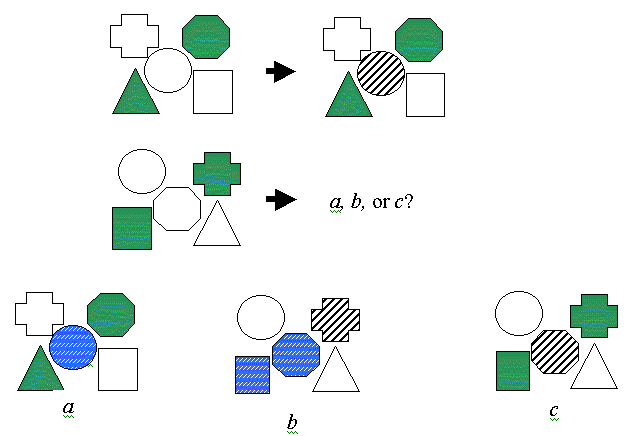
Or, to trot out another analogy, life is like a chess game, and babies are like beginners looking at a complex scene on a board, not having the faintest idea how to organize it into higher-level structures. As has been well known for decades, experienced chess players chunk the setup of pieces on the board nearly instantaneously into small dynamic groupings defined by their strategic meanings, and thanks to this automatic, intuitive chunking, they can make good moves nearly instantaneously and also can remember complex chess situations for very long times. Much the same holds for bridge players, who effortlessly remember every bid and every play in a game, and months later can still recite entire games at the drop of a hat.

All of this is due to chunking, and I speculate that babies are to life as novice players are to the games they are learning."

Now folks, I think we will leave the next riddle until another time since that has you rolling in the aisles. Seriously, stay with Dead Beat. Think about what Hof is revealing to us.

Complex chess moves, complex writing techniques. Chess masters, word masters. We have a 'giant repertoire of concepts in our minds' which we can utilize in the pulling together of the vast array of formal techniques available to us. Automatic intuitive chunking. We do it all the time. Let us learn to do it even better.

Great Writing and the Appreciation of Analogy

q

Mapping and analogy. Go back and re-read if you have forgotten. This is important stuff, Dead Beat does not lie.


Remember Hofstadter is concerned with developing computer models of how human thinking works. You see this is the core of it. We can talk about form in writing. We can 'instruct' in the craft - characters, setting, line, imagery, rhythm and so on, but how do we utilize it? What is happening in the minds of writers?


Why do two people with the same understanding of form produce different 'qualities' of work?


What makes a great poet great? We know what is happening on the page - we can see formally what has occurred? But what happened in the mind to allow this to occur? What processes were at work? And if we could model them, could we then 'teach' them?


Could we become better writers?


Dead Beat says, you bet!


Keep in mind that 'the great poet' probably does not really know what is occurring in his or her mind.


So analogy. Here is what Hofstadter says: One should not think of analogy-making as a special variety of reasoning (as in the dull and uninspiring phrase “analogical reasoning and problem-solving,” a long-standing cliché in the cognitive-science world), for that is to do analogy a terrible disservice. After all, reasoning and problem-solving have (at least I dearly hope!) been at long last recognized as lying far indeed from the core of human thought. If analogy were merely a special variety of something that in itself lies way out on the peripheries, then it would be but an itty-bitty blip in the broad blue sky of cognition. To me, however, analogy is anything but a bitty blip — rather, it’s the very blue that fills the whole sky of cognition — analogy is everything, or very nearly so, in my view."


So what is analogy and how can we utilize it to improve our writing abilities:?


Stay with Dead Beat, he has Hof''s ear.

Great Writing and the Appreciation of Analogy


Mapping and analogy. Go back and re-read if you have forgotten. This is important stuff, Dead Beat does not lie.


Remember Hofstadter is concerned with developing computer models of how human thinking works. You see this is the core of it. We can talk about form in writing. We can 'instruct' in the craft - characters, setting, line, imagery, rhythm and so on, but how do we utilize it? What is happening in the minds of writers?


Why do two people with the same understanding of form produce different 'qualities' of work?


What makes a great poet great? We know what is happening on the page - we can see formally what has occurred? But what happened in the mind to allow this to occur? What processes were at work? And if we could model them, could we then 'teach' them?


Could we become better writers?


Dead Beat says, you bet!


Keep in mind that 'the great poet' probably does not really know what is occurring in his or her mind.


So analogy. Here is what Hofstadter says: One should not think of analogy-making as a special variety of reasoning (as in the dull and uninspiring phrase “analogical reasoning and problem-solving,” a long-standing cliché in the cognitive-science world), for that is to do analogy a terrible disservice. After all, reasoning and problem-solving have (at least I dearly hope!) been at long last recognized as lying far indeed from the core of human thought. If analogy were merely a special variety of something that in itself lies way out on the peripheries, then it would be but an itty-bitty blip in the broad blue sky of cognition. To me, however, analogy is anything but a bitty blip — rather, it’s the very blue that fills the whole sky of cognition — analogy is everything, or very nearly so, in my view."


So what is analogy and how can we utilize it to improve our writing abilities:?


Stay with Dead Beat, he has Hof''s ear.

Friday, March 09, 2007

The Writer as an Analogy-Hungry Perceiving Machine


What with Baudrillard ceasing to exist and all, you thought I had forgotten about old Hofs, didn't you. Well no. Hofs exists even if he has to tell us himself in a self-referential way.


Anyway he looks up from his desk in Indiana and sees me sitting there.


"It is I," I say.


"I say it is," he replies smiling broadly.


"Directly or indirectly?"


Broader smile. "I would say they are just distant points on a continuum. The question is one of reference in general. The essence is simply that one thing refers to another whenever, to a conscious being, there is sufficiently compelling mapping between the roles the two things are perceived to play in some larger structures or systems. Caution is needed here, Dead Beat. By "conscious being" I mean an analogy-hungry perceiving machine that gets along in the world thanks to its perceptions."


"I?"


"Continuously."


"I am a writer."


"That, my dear conscious being is precisely why I am telling you these things."

Wednesday, February 28, 2007

I Bet You Can't Repeat The Title Of This Blog!


Hofstadter talks about viral sentences: self-replicating sentences, sentences which reproduce through an appropriate host. A very simple example would be, "Say me!" The sentence is asking to be said. If we oblige, it replicates and can clearly spread.


Sometimes they come with bribes or threats. "If you copy me, I'll grant you three wishes." "Say me or I'll put a curse on you."


Chain letters operate on the same premise.


More concerning perhaps are self-replicating sentences that are in fact self-replicating ideas: "The bourgeoise is oppressing the proletariat." The repetition of the statement is "driven by a desire to protect a victim figure from a villian figure".


As writers, we ignore the above at our peril.


Step aside for one moment: Hofstadter quotes from a letter he received from Stephen Walton: A manuscript sent to an editor may be considered viral, even though it contains no explicit self-reference, because it is attempting to secure its own reproduction through an appropriate host; the same manuscript sent to someone who has nothing to do with publishing may have no viral quality at all.


What are reject letters then but anti-virals?


As writers we seek to reproduce ideas and other abstractions. We do this through the basic unit of the word and through the sentence. In fact words are by the very nature of language, by the very nature of their existence in the language we use, self-replicating. The structure of a sentence is self-replicating by its very definition. And what of the structure of poems and stories? Oh yes we are an infectious bunch indeed.


P.S. If you enjoyed this post, please send it to a friend. If you did not enjoy it, please show it to someone you know as an example of a post you did not enjoy.