Add to Technorati Favorites

Alter Egos - I Am Done Watching This

When clicking on an Alter Egos in the sidebar, please look above this title for video content.
Showing posts with label The Creative Process. Show all posts

Monday, November 19, 2007

Grammar Girl

Okay, Dead Beat is in Pod Cast Heaven.

Listen up: Grammar Girl

Go to her deal on prepositions.

For now here are the comments:


Amy Says:11/2/2007 5:11:58 PM We have a joke here in Boston about this: Harvard freshman: Where's the Library at? Harvard senior: Here at Hahvahd we don't end our sentences with a preposition. Harvard freshman: OK, then, where's the library at, asshole?
richard Says:11/2/2007 3:23:04 PM i like double negatives i noticed that there are no comments with no responces!! there one ha ! ha! see ya
John Says:11/2/2007 3:00:50 PM That is the sort of English up with which I shall not put!
Paul Says:11/1/2007 6:58:12 PM Great show -- I just started listening. To prove I was paying attention, I spotted your illicit use of "so" (which you critique in another episode) in this episode, as in "I'm so sorry—the horror—because that is one of the instances where it's not OK to end a sentence with a preposition!" :)
Lauren Hightower Says:10/16/2007 9:34:13 AM Great episode!
Mark Says:9/25/2007 2:50:39 PM The important point here is that grammarians are pretty much irrelevant to everyday life - they're pretty much like archaeologists, they like to think they're doing something important but really they're only commenting on things which have already passed their sell by date.
William Says:9/21/2007 8:36:14 PM `Grammatical' is improper English. The correct adjective form of `grammar' is `grammatic'. `Grammatically' is the correct adjective form.
ligneus Says:9/20/2007 8:22:29 AM "What did you bring that book I didn't want to be read to out of up for?"
Doug Rosbury Says:9/18/2007 9:50:19 PM grammatical rules Are only a guide. In my opinion, people should not be held responsible for carrying the torch of grammatical correctness. There is a certain charm in colloquialisms which Give the language color and humor. Don't put me in a prison of correctness. Doug Rosbury
B_allW@yz_unKn0wn Says:9/18/2007 2:51:04 PM i understand what everyone else is saying but i didnt even read it but if i did i would leave you saying its always important to read what you talk about...

My old friend Douglas Hofstadter is chuckling away.

Sunday, March 11, 2007

Dead Beat Poses Some Riddles

Hof has two riddles for us. Well you know Dead Beat, he has a sense of humour. He likes riddles. So Hofs, sock it to us.

"Two Riddles

We begin with a couple of simple queries about familiar phenomena: “Why do babies not remember events that happen to them?” and “Why does each new year seem to pass faster than the one before?”

I wouldn’t swear that I have the final answer to either one of these queries, but I do have a hunch, and I will here speculate on the basis of that hunch. And thus: the answer to both is basically the same, I would argue, and it has to do with the relentless, lifelong process of chunking — taking “small” concepts and putting them together into bigger and bigger ones, thus recursively building up a giant repertoire of concepts in the mind.

How, then, might chunking provide the clue to these riddles? Well, babies’ concepts are simply too small. They have no way of framing entire events whatsoever in terms of their novice concepts. It is as if babies were looking at life through a randomly drifting keyhole, and at each moment could make out only the most local aspects of scenes before them. It would be hopeless to try to figure out how a whole room is organized, for instance, given just a keyhole view, even a randomly drifting keyhole view.

Or, to trot out another analogy, life is like a chess game, and babies are like beginners looking at a complex scene on a board, not having the faintest idea how to organize it into higher-level structures. As has been well known for decades, experienced chess players chunk the setup of pieces on the board nearly instantaneously into small dynamic groupings defined by their strategic meanings, and thanks to this automatic, intuitive chunking, they can make good moves nearly instantaneously and also can remember complex chess situations for very long times. Much the same holds for bridge players, who effortlessly remember every bid and every play in a game, and months later can still recite entire games at the drop of a hat.

All of this is due to chunking, and I speculate that babies are to life as novice players are to the games they are learning."

Now folks, I think we will leave the next riddle until another time since that has you rolling in the aisles. Seriously, stay with Dead Beat. Think about what Hof is revealing to us.

Complex chess moves, complex writing techniques. Chess masters, word masters. We have a 'giant repertoire of concepts in our minds' which we can utilize in the pulling together of the vast array of formal techniques available to us. Automatic intuitive chunking. We do it all the time. Let us learn to do it even better.

Great Writing and the Appreciation of Analogy

q

Mapping and analogy. Go back and re-read if you have forgotten. This is important stuff, Dead Beat does not lie.


Remember Hofstadter is concerned with developing computer models of how human thinking works. You see this is the core of it. We can talk about form in writing. We can 'instruct' in the craft - characters, setting, line, imagery, rhythm and so on, but how do we utilize it? What is happening in the minds of writers?


Why do two people with the same understanding of form produce different 'qualities' of work?


What makes a great poet great? We know what is happening on the page - we can see formally what has occurred? But what happened in the mind to allow this to occur? What processes were at work? And if we could model them, could we then 'teach' them?


Could we become better writers?


Dead Beat says, you bet!


Keep in mind that 'the great poet' probably does not really know what is occurring in his or her mind.


So analogy. Here is what Hofstadter says: One should not think of analogy-making as a special variety of reasoning (as in the dull and uninspiring phrase “analogical reasoning and problem-solving,” a long-standing cliché in the cognitive-science world), for that is to do analogy a terrible disservice. After all, reasoning and problem-solving have (at least I dearly hope!) been at long last recognized as lying far indeed from the core of human thought. If analogy were merely a special variety of something that in itself lies way out on the peripheries, then it would be but an itty-bitty blip in the broad blue sky of cognition. To me, however, analogy is anything but a bitty blip — rather, it’s the very blue that fills the whole sky of cognition — analogy is everything, or very nearly so, in my view."


So what is analogy and how can we utilize it to improve our writing abilities:?


Stay with Dead Beat, he has Hof''s ear.

Great Writing and the Appreciation of Analogy


Mapping and analogy. Go back and re-read if you have forgotten. This is important stuff, Dead Beat does not lie.


Remember Hofstadter is concerned with developing computer models of how human thinking works. You see this is the core of it. We can talk about form in writing. We can 'instruct' in the craft - characters, setting, line, imagery, rhythm and so on, but how do we utilize it? What is happening in the minds of writers?


Why do two people with the same understanding of form produce different 'qualities' of work?


What makes a great poet great? We know what is happening on the page - we can see formally what has occurred? But what happened in the mind to allow this to occur? What processes were at work? And if we could model them, could we then 'teach' them?


Could we become better writers?


Dead Beat says, you bet!


Keep in mind that 'the great poet' probably does not really know what is occurring in his or her mind.


So analogy. Here is what Hofstadter says: One should not think of analogy-making as a special variety of reasoning (as in the dull and uninspiring phrase “analogical reasoning and problem-solving,” a long-standing cliché in the cognitive-science world), for that is to do analogy a terrible disservice. After all, reasoning and problem-solving have (at least I dearly hope!) been at long last recognized as lying far indeed from the core of human thought. If analogy were merely a special variety of something that in itself lies way out on the peripheries, then it would be but an itty-bitty blip in the broad blue sky of cognition. To me, however, analogy is anything but a bitty blip — rather, it’s the very blue that fills the whole sky of cognition — analogy is everything, or very nearly so, in my view."


So what is analogy and how can we utilize it to improve our writing abilities:?


Stay with Dead Beat, he has Hof''s ear.

Monday, March 05, 2007

The Cybernetic Poet


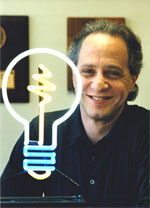
Okay, Ray Kurtzweil, one of the great innovaters of Artificial Intelligence, gets on the phone.

"Is that you, Dead Beat?"
"Who you?"
"Kurtzweil."
"Sorry Kurt before you ask, no I don't have any intelligence to give away, artificial or otherwise."
"We all know that, D.B. It's not that I'm calling about. It's your last post on Creative Computing."

"Yeah, I like that one."

"Just to let you know I already did it."

"Did what?"

"Write a program for computers to write poetry."

"You kidding me?"

"No. The computer reads a selection of poetry and then creates a 'language model' and writes original poems from that model. So far it writes stanzas of poetry. A more difficult problem than writing stanzas of poetry is writing complete poems that make thematic, syntactic, and poetic sense across multiple stanzas, but that's on the way. Computer generated music and art is already well progressed. Oh yeah, Hofs knows what he is talking about. Don't you forget it."

"I don't intend to."

"By the way Dead Beat, you might want to download a free copy. In fact I read your poems...you need to download a free copy."

The Cybernetic Poet

Creative Computing

So, Ada Lovelace, Lord Byron's daughter. Computers. Babbage.

That's where we were. Hofstadter of course looking over our shoulder.

Well there is an old argument concerning Artificial Intelligence and whether computers can ever capture the essence of the mind.

Not so, Ada says, because a computer can never, in and of itself, be creative.

Not so! Old Hofs insists. He claims that the essence of creativity is pursuing a theme through all its possible outcomes and being clever enough to recognize a bright new possibility with the combinations that emerge. Others have similarly argued that creativity can be explained as a process combining exploration and recognition.

Margaret Boden, Cognitive Scientist with all the hoop-la distinguishes three degrees of creativity: 1) The simplest type of creativity occurs when one explores permutations and combinations exhaustively, hoping for an inspired change; 2) The next degree of creativity involves exploring an unknown space, that is, a dimension or variable that has not been used before; 3) The third and highest degree of creativity is again when one explores a space but this is a space that has been transformed in a way that others have not considered.

Can a computer be programmed to pursue these three stages? Why ever not?

And what about us, this vast pool of shoddy writers that we are? Can we pursue these stages more effectively? Or are we going to let our computers write better novels and poems than we do?

Yeah, you're right, most probably.