Alter Egos - I Am Done Watching This
When clicking on an Alter Egos in the sidebar, please look above this title for video content.

Dead Beat does not normally quote Ma'am Thatcher, but he likes what she had to say about Milton Friedman who died Thursday aged 94.
"Milton Friedman revived the economics of liberty when it had been all but forgotten... He was an intellectual freedom fighter. Never was there a less dismal practitioner of a dismal science."
Not too sure about the dismal science part, but I know what she is getting at.
Now why is Dead Beat acknowledging Friedman's death as he acknowledged recently the death of architect Sam Stephenson? Well like Stephenson Friedman was an architect too - as all of us would be writers are.
If we can grasp what has been achieved in architectural design, in economic design, to name just a few cultural arts, we have a better chance of achieving a literary design which applies to our culture.
You cannot separate Economics from Literature - neither stands alone. Each aspect of our society thrives and is dependent on the other.
Friedman was a believer in the principles of 18th century economist Adam Smith, and he consistently argued that individual freedom should rule economic policy.
In an essay titled "Is Capitalism Humane?" Friedman said that "a set of social institutions that stresses individual responsibility, that treats the individual ... as responsible for and to himself, will lead to a higher and more desirable moral climate."
Each one of us who puts pen to paper (or 1s to 0s) must be as aware of this 'moral climate' and must use literary techniques to lead society towards it.
Intellectual Freedom Fighters take up your pens and prepare for battle.

Just heard that fellow Irish man (the similarities end there) and Nobel Prize winning poet, Seamus Heaney suffered a stroke but is in recovery.
Dead Beat wishes him a speedy recovery. Here's a wee reminder:
Death of a Naturalist
All the year the flax-dam festered in the heart
Of the townland; green and heavy headed
Flax had rotted there, weighted down by huge sods.
Daily it sweltered in the punishing sun.
Bubbles gargled delicately, bluebottles
Wove a strong gauze of sound around the smell.
There were dragon-flies, spotted butterflies,
But best of all was the warm thick slobber
Of frogspawn that grew like clotted water
In the shade of the banks. Here, every spring
I would fill jampots full of the jellied
Specks to range on the window-sills at home,
On shelves at school, and wait and watch until
The fattening dots burst into nimble-
Swimming tadpoles. Miss Walls would tell us how
The daddy frog was called a bullfrog
And how he croaked and how the mammy frog
Laid hundreds of little eggs and this was
Frogspawn. You could tell the weather by frogs too
For they were yellow in the sun and brown
In rain.
Then one hot day when fields were rank
With cowdung in the grass the angry frogs
Invaded the flax-dam; I ducked through hedges
To a coarse croaking that I had not heard
Before. The air was thick with a bass chorus.
Right down the dam gross-bellied frogs were cocked
On sods; their loose necks pulsed like snails. Some hopped:
The slap and plop were obscene threats. Some sat
Poised like mud grenades, their blunt heads farting.
I sickened, turned, and ran. The great slime kings
Were gathered there for vengeance and I knew
That if I dipped my hand the spawn would clutch it.
I want to return us to The Subordination of Literature - that's the problem with these blogs you see - we run from a subject to quickly - read it, got something from it or didn't, move on. All too fast - how are we going to learn anything? D. B. generally tries to drag it out - come at it from a number of different angles - but ultimately be approaching the same 'idea'. All the same he gets side-tracked too....
But listen to my buddy Gardner: "Life is all about, and this and this and this. Literature is about subordination. It's about this because of this. This although that. This in spite of that. And that's the difference."
The difference between life and literature. Now remember what Ford told us in The Imaginative Gesture of Literature: "You only give rise to the need for imaginative gestures like literature when the facts prove inadequate."
There's this and there's this and there's this. Facts, inadequacy.
So we imagine that it is about this because of this. Or we imagine that although we have this we also have that. Or that we have this in spite of that.
We create imaginary people in imaginary worlds to imagine beyond the facts to some greater truth.
Don't rush this. Let us take our time. Think on it a while. Then come back to it and think again.
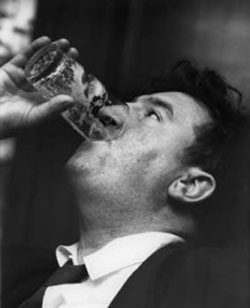
On the subject of the Bould Brendan Behan (See Sam Stephenson and Brendan Behan), he and Dead Beat shared many a pint of Guinness in Mc Daids where Brendan would give Dead Beat an earful.
A few morsels for your pleasure:
I am a drinker with writing problems.
“It's not that the Irish are cynical. It's rather that they have a wonderful lack of respect for everything and everybody.”
“To get enough to eat was regarded as an achievement. To get drunk was a victory.”
"There is no such thing as bad publicity except your own obituary.”
"I never turned to drink. It seemed to turn to me."
"An author's first duty is to let down his country."
"I only take a drink on two occasions - when I'm thirsty and when I'm not."
May your thirst be quenched.

Like any self-respecting writer Dead Beat is a fan of architecture and notes the passing of Sam Stephenson, one of Ireland's most controversial and creative architects.
Dead Beat likes this story Sam used to tell about that other controversial Irish man, Brendan Behan:
On the day I arrived home from my honeymoon, all we had in the flat was a cooker, bed, and a round table and chairs that I had built myself. At the time Brendan Behan was living upstairs. He barged in one morning to use the phone; he wanted to ring the pawn shop to see how much he'd get for his typewriter and when he saw the state of the place he gave my young bride some typical Behan advice - 'don't worry, he told her, 'all you need is a bed, a table and a corkscrew anyway'.

Just a snippet: Ford again
"Wait until the facts become surmountable. You only give rise to the need for imaginative gestures like literature when the facts prove inadequate."

You see Dead Beat instructs adults, youth, beginning writers, emerging....
One thing he tells them all is that all writers no matter how great are still dealing with the same basic elelements of form: in the story - plot, characterisation, setting, theme... Better writers just do it at a higher level.
This I believe is terribly reassuring - so it was wonderful to hear Richard Ford talking about learning to add more details to his characters and how he is not very good at writing in the third person.
Always learning, never too old.

"So Dickie, (See Richard Ford and Dead Beat Mix It Up) I'm thinking about your characters. Sometimes very detailed, sometimes not so."
"Okay Dead Beat, here's the truth. I reached a point two or three years ago where I realized I wasn't doing enough of what I needed to be doing when it came to describing people. When it came to finding a way for the reader to actually physically envision people. Some of that comes with writing in the third person. Writing in the first person, a character describing herself or himself is a little unpersuasive. In the third person it becomes absolutely essential. I wanted to write in the third person because it's one of the things I feel that I don't do very well. One of the things I did was to set a task to try to make myself do it better. To try to describe people more. How they looked, what they wore, what their faces were like. I'm always reading my colleagues...Ian McKewen, for instance, He'll spend a whole paragraph doing something that I would have thought heretofore I would have got away with not doing at all. Or maybe half or a third as much. I decided I would do it more because maybe I could do it better. It might make the characters more vivid. Maybe it was just an opportunity to write, that I could seize."
So Dead Beaters think about this, first person versus third in characterisation - point of view always has advantages and disadvantages - it's a question of balance, weighing it up.

"John (Gardner)," Dead Beat says, "They give your book On Moral Fiction a hard time."
"You go with the blows Dead Beat."
"I kind of like your take on the Subordination of Literature."
"And so you should."
"Why don't you remind my readers Mr. G?"
"Well it's simple really: "Life is all about, and this and this and this. Literature is about subordination. It's about this because of this. This although that. This in spite of that. And that's the difference."
Simple really.

Dead Beat occasionally works with Government Agencies - Impact Writing, reports that sort of mundane but hugely important persuaders of policy.
Anyway, he also works with Grade 5 and 6 children, junior and senior high schoolers:"don't use words like 'like' and 'stuff'. "What does 'stuff' mean? - too abstract - people cannot understand what it is you are talking about - you need to be specific."
Now you are talking to young children, now you are talking to a terrorist organisation you are tempting into main stream politics:
Listen here to the Prime Minister of Ireland talking about the Political wing of the IRA (The Irish Republican Army), Sinn Fein and why he would not go into power with them in a coalition in the next election :
""I've given 25 years of my life to this stuff, but that is all anathema to Sinn Fein. Sinn Fein don't believe in or agree with that stuff. They are anti-Europe. I've been over with the Commission and Sinn Fein have no time for those guys. In all the things that I've spent all my life working in, they have a totally different view," Mr Ahern said.
Bertie Ahern, Prime Minister of Ireland, talking about the most important decision in the recent history of our state - not their violent links, their parlimilitary base, but 'stuff' and 'guys' - Wise Guys no doubt.
Learn to read, and learn to write.
Apply for senior postion in Irish Government thereafter.