Harold Pinter
"And so I say to you, tender the dead as you would yourself be tendered, now, in what you would describe as your life."
Award winning Irish writer. Literary thoughts and literary advice. Author of The Eskimo in the Net (shortlisted for The Kerry Group Irish Fiction Award) and Sightings of Bono (adapted for film featuring Bono (U2). Poetry (Digging My Own Grave 2nd place in Patrick Kavanagh Award), Fiction. Creative Writing instructor and Mentor.
"And so I say to you, tender the dead as you would yourself be tendered, now, in what you would describe as your life."
Posted by
Dead Beat
at
12:11 AM
0
comments
Links to this post
Labels: The Mortality of Writing
'Death'.
Where was the dead body found?
Who found the dead body?
Was the dead body dead when found?
How was the dead body found?
Who was the dead body?
Who was the father or daughter or brother
Or uncle or sister or mother or son
Of the dead and abandoned body?
Was the body dead when abandoned?
Was the body abandoned?
By whom had it been abandoned?
Was the dead body naked or dressed for a journey?
What made you declare the dead body dead?
Did you declare the dead body dead?
How well did you know the dead body?
How did you know the dead body was dead?
Did you wash the dead body
Did you close both its eyes
Did you bury the body
Did you leave it abandoned
Did you kiss the dead body
Posted by
Dead Beat
at
11:26 PM
0
comments
Links to this post
Labels: The Death of Writing
D. B. had the checks, the convertible - bright blue. He was hurrying down the chimney.
This is the truth - he told his children the sad news of the great one's passing and just as he paused and watched their reaction, his CD player (on random) began to play Santa Baby.
Eartha D.B. is stuck in the chimney forever. Thank you.
Posted by
Dead Beat
at
10:17 PM
0
comments
Links to this post
40 years ago and forever old!
Posted by
Dead Beat
at
12:34 AM
0
comments
Links to this post
God is...
Posted by
Dead Beat
at
10:44 PM
0
comments
Links to this post
We've laid the cables and the wires
We've split the wood and stoked the fires
We've lit our town so there is no
Place for crime to hide
Our little church is painted white
And in the safety of the night
We all go quiet as a mouse
For the word is out
God is in the house
God is in the house
God is in the house
No cause for worry now
God is in the house
Moral sneaks in the White House
Computer geeks in the school house
Drug freaks in the crack house
We don't have that stuff here
We have a tiny little Force
But we need them of course
For the kittens in the trees
And at night we are on our knees
As quiet as a mouse
For God is in the house
God is in the house
God is in the house
And no one's left in doubt
God is in the house
Homos roaming the streets in packs
Queer bashers with tyre-jacks
Lesbian counter-attacks
That stuff is for the big cities
Our town is very pretty
We have a pretty little square
We have a woman for a mayor
Our policy is firm but fair
Now that God is in the house
God is in the house
God is in the house
Any day now
He'll come out
God is in the house
Well-meaning little therapists
Goose-stepping twelve-stepping
Tetotalitarianists
The tipsy, the reeling and the drop down pissed
We got no time for that stuff here
Zero crime and no fear
We've bred all our kittens white
So you can see them in the night
And at night we're on our knees
As quiet as a mouse
Since the word got out
From the North down to the South
For no-one's left in doubt
There's no fear about
If we all hold hands and very quietly shout
Hallelujah
God is in the house
God is in the house
Oh I wish He would come out
God is in the house
Posted by
Dead Beat
at
10:19 PM
0
comments
Links to this post
Labels: The Music of Writing
Most Americans have long known that the horrors of Abu Ghraib were not the work of a few low-ranking sociopaths. All but President Bush’s most unquestioning supporters recognized the chain of unprincipled decisions that led to the abuse, torture and death in prisons run by the American military and intelligence services.
Posted by
Dead Beat
at
11:12 PM
0
comments
Links to this post
Labels: The Death of Writing
Posted by
Dead Beat
at
11:09 PM
0
comments
Links to this post
Labels: The Intelligence of Writing
Posted by
Dead Beat
at
11:05 PM
0
comments
Links to this post
Labels: The Death of Writing
Posted by
Dead Beat
at
12:32 AM
0
comments
Links to this post
Labels: The Spirituality of Writing
Paradise Lost, Milton, Book I: the raising of Pandemonium:
There stood a Hill not far whose griesly top
Belch'd fire and rowling smoak; the rest entire
Shon with a glossie scurff, undoubted sign
That in his womb was hid metallic Ore,
The work of Sulphur. Thither wing'd with speed
A numerous Brigad hasten'd. As when bands
Of Pioners with Spade and Pickaxe arm'd
Forerun the Royal Camp, to trench a Field,
Or cast a Rampart. Mammon led them on,
Mammon, the least erected Spirit that fell
From heav'n, for ev'n in heav'n his looks & thoughts
Were always downward bent, admiring more
The riches of Heav'ns pavement, trod'n Gold,
Then aught divine or holy else enjoy'd
In vision beatific: by him first
Men also, and by his suggestion taught,
Ransack'd the Center, and with impious hands
Rifl'd the bowels of thir mother Earth
For Treasures better hid. Soon had his crew
Op'nd into the Hill a spacious wound
And dig'd out ribs of Gold. Let none admire
That riches grow in Hell...
Posted by
Dead Beat
at
10:28 PM
0
comments
Links to this post
Labels: Science of Writing, The Poetry of Writing
Posted by
Dead Beat
at
10:15 PM
0
comments
Links to this post
Labels: The Art of Writing
In 1958 you wrote "Pandemonium". What does pandemonium mean? What was the concept of this?
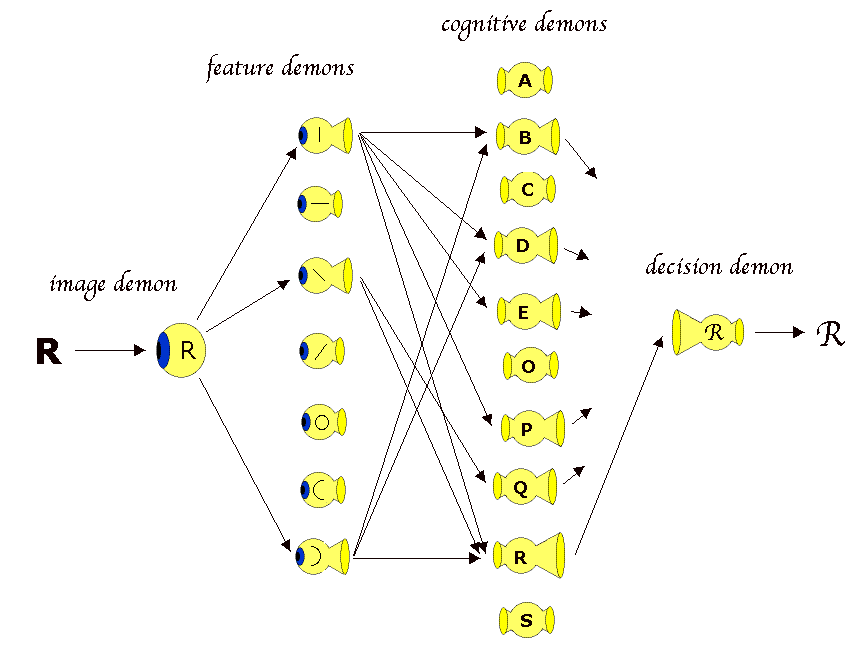
The concept, "pandemonium" was a word first used by John Milton in a very long English poem called "Paradise Lost". Pandemonium comes from the Greek "pan", meaning all and "demonium", meaning the demons. The idea of pandemonium is that in recognizing something - for example, recognizing a face or a character on a page - we have a little demon for each feature, for each part of the picture. And when the demons see themselves in the picture they shout, That's me! That's me! and then a higher level demon listens to these other demons and decides who shouts the loudest. If you are reading a character, a letter in a word, if the higher level demon hears the "A" demon shout the loudest, then he knows it is an "A". The idea is that we have separate neural nets, say, representing the demons, and what they shout, their output, is the amount of themselves that they see, that they perceive in what they are looking at.
So it's a network of neural networks at the end.
Yes, in the long run neural networks will have to be built up of pieces that are neural networks. But they still have to work together. Then the whole system does not have simple purposes or goals but very complex ones, just like people. In that sense the neural network is very different from the network of computers which we are talking about now because here it is a social thing. In our society not every piece, not every computer wants the same thing. They want to communicate but not because there is a single purpose; they want to communicate because everybody wants to do something different. In the neural network, in the good neural networks, they are all contributing to the same end.
Posted by
Dead Beat
at
9:20 PM
0
comments
Links to this post
Question 1: What are neural networks?
Answer: A neural network is a model of the way real nerves, real sensors like eyes and ears and brains, work. It tries to imitate so that it will work in the same way and do the same things.
Question 2: E' possibile costruire macchine, computer e altre apparecchiature con le reti neurali?
Answer: It is possible. We believe that our thinking works in a way like that and we want to find out how real brains work, and also to build machines to do some of the same things that our brains, our minds do.
Question 3: But these machines are not programmable. Will they learn by themselves?
Answer: One hopes so. They do learn by themselves, by their own experiences but not as much as people do. They are still very simple. The kinds of tasks that these machines can now do are low-level tasks. As science improves, as the engineers and scientists, the people at SMAU, work them and practice with them they get better, but they are still very far from real people.
Question 4: Can you compare the ability of neural networks with the ability of animals or children?
Answer: It is not an age so much. The neural network in the machine keeps trying, but an intelligent child stops trying after a while and gets bored. Our machines do not get bored yet, which is a sign that they are very elementary indeed. There are tasks which they can do for us. They will keep track of the right way to do a very easy task. But as yet they do not have much sense of purpose of their own beyond what they are given by the people who build them.
Question 5: That is interesting because they have to understand from the environment. How can they understand from the environment?
Answer: That is a very interesting point. It is not that they understand so much, it is that they work with the environment to get something done, to perceive something, to have the right effect. But they do not really understand what the environment is or how it works. So neural networks today do not make a model of the environment in the way that you and I make a model of the environment, instead they merely play with what they can do until it works.
Question 6: And can you compare the goals of cybernetics and the goals of neural networks?
Answer: The goals of neural networks are much more cybernetic than present day computers. Our computers are nearly all programmed, that is, they are told exactly what to do. Neural networks are not told exactly what to do. The study of cybernetics started out with Professor Norbert Wiener at MIT, who was my adviser, studying how gets to a particular place. The word cybernetics comes from the Greek word for the steersman on a boat, who moved the tiller or the rudder to get the boat where he wanted to go. The steersman is performing the goal, the seeking of the goal, the going where he wants to. At a very low level neural networks move their connections and rewire themselves so that the machine will do what it is programmed to want to do. In computers the programs are written so the machine will do what the designer wants them to do. So the machines in computers do not want. Neural networks are beginning to want, to care, to have purpose.
Posted by
Dead Beat
at
9:10 PM
0
comments
Links to this post
Posted by
Dead Beat
at
8:47 AM
0
comments
Links to this post
So Odetta has taken the hammer and brought it back to Leadbelly.
Posted by
Dead Beat
at
8:52 PM
0
comments
Links to this post